
Goal setting & vision mapping are powerful, interconnected processes that give you clarity, focus, and direction in your personal and spiritual life. By intentionally defining your goals and visually mapping out your vision, you create a tangible roadmap that transforms abstract dreams into actionable steps.
This holistic approach aligns your ambitions with your deeper values and purpose, making goal achievement not just about outcomes but also about personal growth and fulfillment.
Vision mapping enhances motivation by engaging both your logical and creative minds—integrating imagery, words, and emotions—while goal setting provides structure and measurable milestones. Together, they foster resilience during setbacks and inspire persistence.
Whether you want to expand your spiritual practice, improve well-being, or achieve life milestones, combining goal setting & vision mapping empowers you to navigate your path with clarity and confidence.
Table of Contents
- Understanding Purpose-Driven Goal Setting
- Crafting a Compelling Vision Statement
- Breaking Down Vision Into SMART Goals
- Creating Your Vision Map
- Prioritizing Goals with Intentional Planning
- Tracking Progress and Adjusting Course
- Cultivating Mindset Habits to Support Vision and Goals

Understanding Purpose-Driven Goal Setting
Goal setting rooted in purpose moves beyond checking boxes and aims to align with your core values and life mission.
Purpose-driven goal setting generates powerful intrinsic motivation, helping you stay committed even when challenges arise.
It encourages you to reflect on what truly matters and avoid distractions that detract from your life’s deeper meaning.
This alignment fosters authentic growth, resilience, and satisfaction.
Goals crafted with purpose become guides and milestones on your transformational journey rather than mere tasks.
Key Practices
- Identify your core values and passions
- Connect goals to your purpose statement
- Use visualization to deepen clarity
- Reflect regularly to ensure alignment
- Break goals into meaningful milestones
- Balance ambition with self-compassion
- Avoid superficial or externally imposed goals
- Cultivate gratitude for progress

Crafting a Compelling Vision Statement
A vision statement is the lighthouse guiding your purpose-driven journey.
It encapsulates where you want to go and who you aspire to become.
Crafting a compelling vision combines introspective reflection with vivid imagination, creating a future that excites and anchors you through uncertainty.
Consider what legacy you want to leave and how your life can impact others positively.
Your vision statement should be clear, inspiring, and revisited often to realign your focus.
Steps to Create Your Vision
- Reflect on your ideal life and legacy
- Write from the present tense as if it’s happening now
- Use inspirational and emotionally charged language
- Keep it concise and memorable
- Visualize living this vision daily
- Share with trusted friends or mentors for feedback
- Align vision with your values and mission
- Update as you grow and evolve
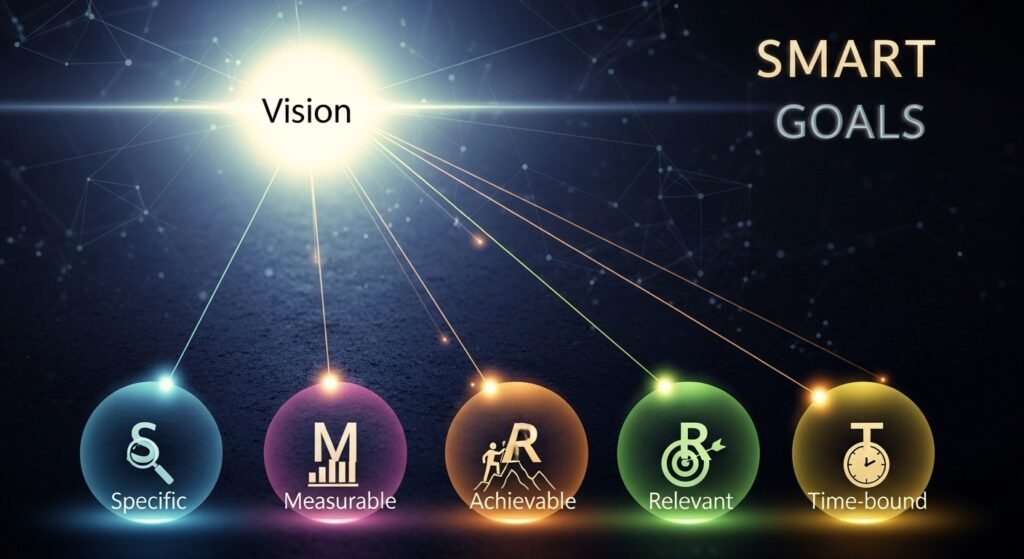
Breaking Down Vision Into SMART Goals
Turning vision into action requires translating it into SMART goals—Specific, Measurable, Achievable, Relevant, and Time-bound.
SMART goals bring clarity and structure, breaking large dreams into bite-sized, manageable steps.
This progression supports accountability and reduces overwhelm, enabling steady forward motion.
Prioritize goals that create the biggest impact toward your vision, and set deadlines to foster urgency and focus.
Regular review keeps goals flexible and aligned with your evolving vision.
How to Set SMART Goals
- Be precise and detailed about what you want
- Include quantitative or qualitative metrics
- Ensure goals are realistically attainable
- Keep goals relevant to your vision and values
- Set clear timelines and deadlines
- Write goals down and track progress
- Break large goals into sub-goals
- Reassess and adjust goals periodically

Creating Your Vision Map
A vision map is a visual and strategic tool that depicts your vision and goals clearly on one page or board.
It creates a tangible overview of your purpose-driven life plan, enriching motivation and focus.
Vision maps often include images, quotes, goal categories, timelines, and action steps to engage multiple senses and deepen commitment.
By externalizing your vision and goals visually, you reinforce your subconscious connection to them daily.
A well-designed vision map acts as a continuous reminder and source of inspiration.
Tips for Effective Vision Mapping
- Choose a large poster, whiteboard, or digital space
- Include your vision statement at the center
- Categorize goals by life areas (career, relationships, health)
- Use images, symbols, and colors meaningfully
- Include key action steps and deadlines
- Place in a visible area for daily review
- Update regularly with progress and new goals
- Use it for guided visualization practice

Prioritizing Goals with Intentional Planning
Intentional goal prioritization is crucial to purpose-driven success.
Not all goals have equal weight or urgency.
Prioritize those aligned most powerfully with your vision and current life stage.
Use planning tools such as daily, weekly, and monthly planners to allocate time and resources effectively.
Focus blocks, batching, and elimination of distractions increase productivity and energy for top priorities.
Balancing flexibility with discipline prevents burnout and sustains momentum.
Prioritization Techniques
- Use Eisenhower’s urgent-important matrix
- Set “top 3” daily and weekly priorities
- Group similar tasks together for batching
- Schedule focus blocks without interruptions
- Use digital or analog planning tools
- Reflect weekly to reassess priorities
- Delegate or eliminate low-impact tasks
- Practice saying “no” to misaligned demands

Tracking Progress and Adjusting Course
Tracking progress transforms goals from intentions into achievements.
Use systematic methods like journals, apps, or spreadsheets to record milestones and insights.
Regular monitoring highlights patterns, celebrates wins, and identifies obstacles.
This feedback loop allows agile adjustments, keeping goals relevant and achievable.
Embracing flexibility nurtures resilience and prevents discouragement.
Reflecting on how actions impact your vision deepens understanding and commitment.
Tracking Best Practices
- Record daily or weekly progress honestly
- Celebrate small wins consciously
- Analyze setbacks without self-judgment
- Adjust timelines or strategies as needed
- Use visual trackers like charts or calendars
- Share progress for accountability
- Review progress in relation to vision monthly
- Combine quantitative and qualitative measures

Cultivating Mindset Habits to Support Vision and Goals
Cultivating mindset habits is crucial for supporting your vision and achieving your goals effectively.
Positive habits such as daily affirmations and visualization reinforce your belief in your ability to succeed and keep your focus sharp.
Practicing mindfulness and meditation helps calm the mind and reduces distractions, ensuring you’re present and aligned with your purpose.
Gratitude shifts your perspective to appreciate progress, boosting motivation and optimism.
Regular reflection nurtures self-awareness and flexibility, allowing you to adapt your approach and maintain consistent commitment toward your vision and goals.
Essential Mindset Habits
- Practice daily affirmations connected to your vision
- Visualize goal achievement vividly
- Keep a gratitude journal focused on progress
- Manage stress with mindfulness or breathwork
- Reflect on lessons from failures
- Surround yourself with supportive influences
- Limit negative self-talk or comparisons
- Commit to continuous learning and adaptation
Detailed Table: Comparison of Goal Setting & Vision Mapping Elements
| Component | Purpose | Key Benefits | Time Required | Tools & Techniques | Ideal Frequency | Accessibility | Impact on Purpose-Driven Success |
|---|---|---|---|---|---|---|---|
| Purpose-Driven Goal Setting | Align actions with values | Inspires authentic motivation | 30-60 mins (initial) | Reflection, visualization | Ongoing review | Highly accessible | Very High |
| Vision Statement | Anchor and guide | Provides clarity and direction | 30-45 mins (initial) | Writing, meditation | Monthly review | Highly accessible | Very High |
| SMART Goals | Structure and clarity | Breaks vision into action steps | 20-30 mins per goal | Templates, planners | Weekly planning | Highly accessible | High |
| Vision Mapping | Visual motivation | Engages multiple senses | 1-2 hours (setup) | Poster board, digital apps | Regular update | Moderate | High |
| Intentional Planning | Efficient resource use | Improves productivity | 10-20 mins daily | Planners, apps | Daily | Highly accessible | Very High |
| Progress Tracking | Feedback & adjustment | Increases accountability | 10-15 mins weekly | Journals, tracking tools | Weekly | Highly accessible | High |
| Mindset Habits | Sustain motivation & resilience | Boosts optimism and focus | 10-20 mins daily | Affirmations, journaling | Daily | Highly accessible | Very High |
Inspirational Quotes on Goal Setting & Vision Mapping
- “A goal without a plan is just a wish.” — Antoine de Saint-Exupéry
- “Your vision will become clear only when you look into your heart.” — Carl Jung
- “SMART goals enable your dreams to be more than just ideas.” — Unknown
- “A clear vision, backed by definite plans, gives you a tremendous feeling of confidence and personal power.” — Brian Tracy
- “Success is the progressive realization of a worthy goal.” — Earl Nightingale
- “Vision without action is daydream. Action without vision is nightmare.” — Japanese Proverb
- “Planning is bringing the future into the present so that you can do something about it now.” — Alan Lakein
- “The future belongs to those who believe in the beauty of their dreams.” — Eleanor Roosevelt
Frequently Asked Questions on Goal Setting & Vision Mapping for a Purpose-Driven Life
- What is purpose-driven goal setting?
It’s aligning your goals with your core values and life mission for deeper motivation. - How does vision mapping enhance goal achievement?
It provides a visual, holistic overview of your goals and inspires ongoing commitment. - What are SMART goals?
Goals that are Specific, Measurable, Achievable, Relevant, and Time-bound for clarity and action. - How often should I review my goals and vision?
Ideally monthly for vision reflection and weekly for goal progress tracking. - Can goal setting work without a clear vision?
It’s less effective; vision provides essential direction and motivation. - What tools help with vision mapping?
Poster boards, digital apps, journals, and vision board software. - How do I stay motivated toward long-term goals?
Regularly revisit your vision, celebrate milestones, and adjust as needed. - What if I miss my goal deadlines?
Reflect on reasons, adjust timelines, and avoid self-judgment—keep moving forward. - Can mindset habits really influence goal success?
Yes, positive mindset practices enhance resilience, focus, and consistency. - Is goal setting flexible?
Absolutely, goals evolve as you grow; flexibility is key to sustained success.
Conclusion
Mastering the art of goal setting and vision mapping is essential for crafting a purpose-driven life filled with clarity, passion, and achievement.
By grounding your goals in purpose, crafting compelling visions, breaking these into SMART goals, and visually mapping them, you create an actionable blueprint for success.
Intentional planning, progress tracking, and mindset cultivation provide the structure and emotional resilience to sustain your journey.
This integrated approach transforms dreams into tangible realities, ensuring your life reflects your highest values and deepest desires.
Commit to these powerful practices today and step confidently into a future you design with purpose and intention.
Case Study
Background
Sarah, a 35-year-old creative professional, felt stuck in her career and disconnected from her deeper purpose despite outward success. Unfulfilled and overwhelmed, she sought to realign her actions with meaningful goals aligned to her values. Sarah decided to apply the art of goal setting and vision mapping to craft a purpose-driven life.
Step 1: Clarifying Purpose and Vision
Sarah began by reflecting deeply on her core values and passions. She identified creativity, community impact, and personal growth as her pillars. She drafted a vivid vision statement: “To inspire others through artistic expression while fostering supportive community spaces and continuously evolving in my craft.”
Step 2: Breaking Vision into SMART Goals
Based on her vision, Sarah set specific goals such as launching a community art workshop within 12 months, publishing her first illustrated book in 18 months, and dedicating 5 hours a week to skill development. Each goal was measurable, attainable, relevant, and had a defined timeline, helping her break down the big picture into achievable milestones.
Step 3: Creating a Vision Map
Sarah created a colorful vision map on a large board at home. Her vision statement was central, surrounded by segmented areas for career, community, creativity, and personal growth, each with goal reminders, inspirational images, and motivational quotes. This visual reminder kept her anchored daily.
Step 4: Prioritizing and Planning
She established weekly priorities aligned with her vision—such as preparing workshop material or writing chapters—and used daily planners to schedule focused time blocks and eliminate distractions. She practiced intentional “no’s” to protect her time and energy for high-impact goals.
Step 5: Tracking Progress & Adapting
Sarah tracked her weekly progress in a journal, celebrating small wins and reflecting on challenges without judgment. When a publishing delay occurred, she adjusted timelines but maintained focus on her evolving vision, learning to balance flexibility and discipline.
Step 6: Cultivating Supporting Mindset Habits
Daily affirmations, gratitude journaling, visualization exercises, and mindfulness practice helped Sarah stay motivated and resilient. She also sought encouragement from a local creative community for accountability and inspiration.
Results
Within two years, Sarah successfully launched her art workshops, published her book, and experienced renewed passion and fulfillment. The alignment with her purpose transformed her professional and personal life, enhancing her creativity and sense of contribution.
Key Takeaways
- Clear vision rooted in core values drives motivation
- Breaking vision into SMART goals makes large ambitions manageable
- Visual tools like vision maps reinforce commitment and focus
- Intentional prioritization and planning protect progress
- Mindset habits sustain motivation and adaptability in challenges
- Community and reflection amplify growth and accountability
This case highlights how mastering goal setting and vision mapping can be a transformative process, turning dreams into reality with clarity, intention, and sustained momentum. Sarah’s journey illustrates the power of purpose-driven planning to create a fulfilling, meaningful life aligned with authentic self-expression and impact.