📋 Table of Contents
- Understanding Intuition vs. Fear: The Fundamental Difference
- Why Most People Confuse Fear with Intuition
- Technique #1: Body Awareness Scanning for Immediate Recognition
- Technique #2: Present Moment Grounding for Clarity
- Technique #3: Timing Recognition – Urgency vs. Calm
- Technique #4: Inner Voice Clarity – Tone and Quality
- Technique #5: Sensory Development for Enhanced Perception
- Technique #6: Pattern Recognition for Future Decisions
- Technique #7: Trust Building Exercises
- Technique #8: Emotional Regulation for Clear Intuition
- Creating Your Daily Intuition vs. Fear Practice
- Common Mistakes and How to Avoid Them
- The Complete Intuition vs. Fear Framework
- Real Transformation Stories
- Frequently Asked Questions
- Your Journey to Intuitive Clarity Begins

🧠 Understanding Intuition vs. Fear: The Fundamental Difference {#understanding-difference}
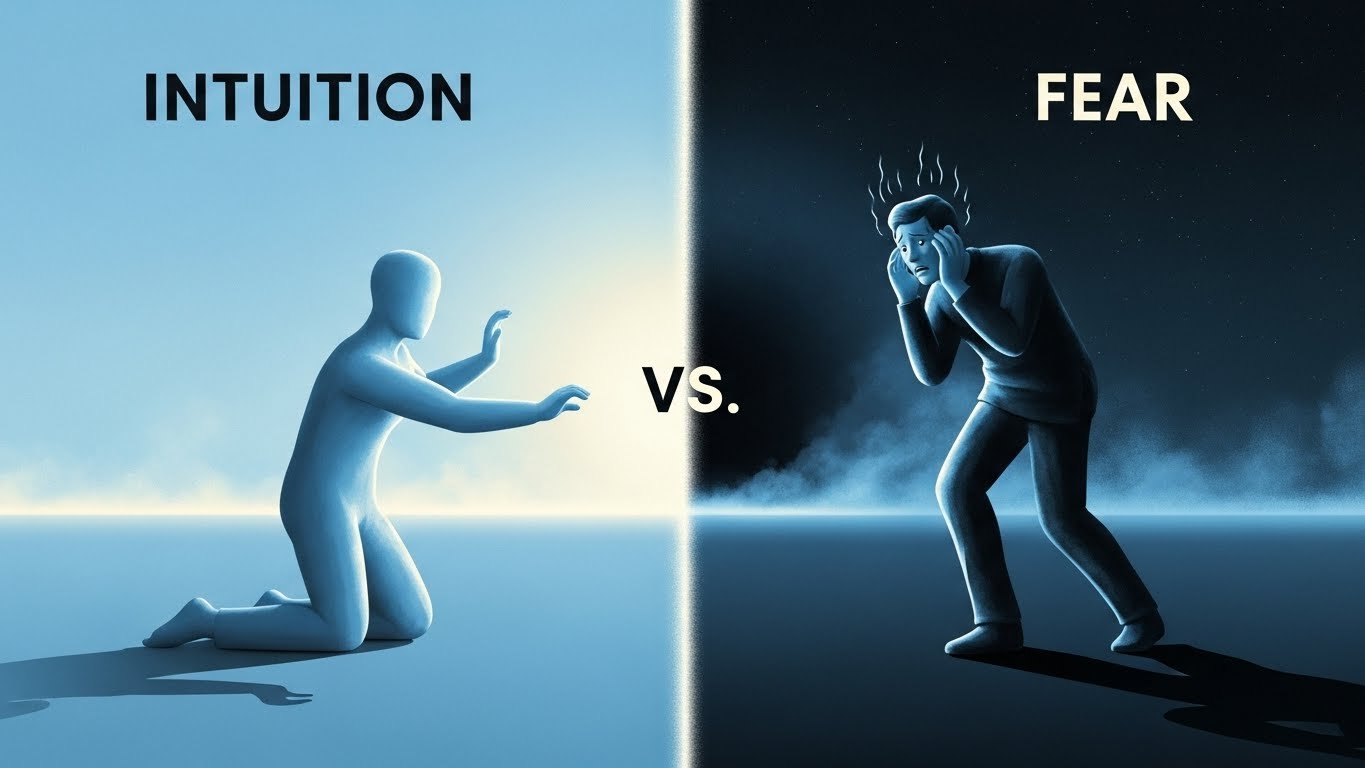
The distinction between Intuition vs. Fear represents one of the most crucial yet misunderstood aspects of human decision-making. Intuition is your authentic inner guidance system – a calm, steady knowing that transcends logical analysis.
Fear, conversely, is your survival mechanism gone awry, creating urgent, often irrational responses to perceived threats.
Research from Harvard Medical School shows that intuition operates through different neural pathways than anxiety, involving the insula and anterior cingulate cortex, while fear triggers the amygdala’s fight-or-flight response.
Intuition feels like a gentle nudge toward what’s right for you, even when it doesn’t make logical sense immediately.
It’s that calm knowing when you meet someone that they’re trustworthy, or the quiet certainty that a career change is right despite external pressure to stay put.
Fear, however, feels like an alarm bell – urgent, loud, and demanding immediate action.
It’s the racing heart when you consider speaking up in a meeting, or the overwhelming dread about making the “wrong” choice that keeps you paralyzed.
The challenge is that both intuition and fear speak to us through feelings and sensations, making them easy to confuse.
However, they create distinctly different physical and emotional signatures. Intuition creates expansion – a sense of opening, clarity, and peace even when facing difficult choices.
Fear creates contraction – tightness, confusion, and urgency that demands immediate resolution.
Learning to recognize these signatures is the first step toward mastering Intuition vs. Fear awareness.
Key Takeaways:
- Intuition is authentic inner guidance; fear is survival mechanism gone awry
- Different neural pathways activate for intuition vs. fear responses
- Intuition creates expansion and clarity; fear creates contraction and confusion
- Both communicate through feelings but create distinct physical/emotional signatures
- Learning to recognize signatures is first step toward mastery
8 Core Differences Between Intuition and Fear:
- Physical Sensation: Expansion vs. contraction in body
- Emotional Quality: Calm knowing vs. urgent anxiety
- Timing Sense: Patient clarity vs. immediate demand
- Voice Tone: Quiet confidence vs. loud alarm
- Decision Quality: Clear direction vs. paralyzing confusion
- Energy Level: Grounded presence vs. drained agitation
- Perspective: Big picture view vs. narrow threat focus
- Aftermath: Peace regardless of outcome vs. relief only if “safe”

🤔 Why Most People Confuse Fear with Intuition {#why-people-confuse}
Most people confuse fear with intuition because both operate below conscious awareness, creating sensations and feelings that seem similar on the surface.
Modern life’s constant stimulation – from social media notifications to 24/7 news cycles – creates chronic low-level anxiety that drowns out intuitive signals.
Research from the American Psychological Association shows that 75% of adults experience moderate to high stress regularly, creating background anxiety that masks intuitive guidance.
The confusion is compounded by cultural narratives that glorify fear-based decision-making.
We’re taught to “be realistic” (focus on potential problems), “stay safe” (avoid perceived risks), and “think logically” (dismiss intuitive feelings).
This conditioning trains us to trust anxious thoughts over calm knowing, leading to decisions made from fear disguised as practicality.
The result is a society where most people operate from survival mode rather than intuitive wisdom.
Additionally, fear often speaks first and loudest. Your amygdala can trigger a stress response in 12 milliseconds – faster than you can blink – while intuitive knowing emerges more gradually from deeper processing centers.
Without training, people often act on the first feeling they notice (fear) without waiting for the quieter, more accurate signal (intuition) to emerge.
Learning to pause and distinguish between these signals is crucial for developing Intuition vs. Fear awareness.
Key Takeaways:
- Both operate below conscious awareness creating similar surface sensations
- Modern chronic stress drowns out intuitive signals
- Cultural narratives glorify fear-based decision-making
- Fear speaks first and loudest, creating timing disadvantage for intuition
- Training required to pause and distinguish between signals
8 Reasons People Confuse Fear with Intuition:
- Speed Difference: Fear reacts in 12 milliseconds vs. intuition’s gradual emergence
- Cultural Conditioning: Taught to trust “realistic” anxiety over “irrational” intuition
- Stress Overload: Chronic anxiety creates background noise masking intuition
- Volume Difference: Fear shouts while intuition whispers
- Educational Bias: Logical thinking valued over intuitive knowing
- Safety Preference: Fear feels safer than uncertain intuitive guidance
- Social Reinforcement: Others validate fear-based decisions more often
- Lack of Training: No education on distinguishing between signals

Technique #1: Body Awareness Scanning for Immediate Recognition {#body-awareness-scanning}
Body awareness scanning is your most immediate tool for distinguishing Intuition vs. Fear because your body responds differently to each signal before your mind can process what’s happening.
Intuition typically creates sensations of expansion – shoulders drop, breathing deepens, muscles relax, even when facing challenging decisions.
Fear creates contraction – shoulders tense, breathing becomes shallow, muscles tighten, stomach knots form.
By learning to scan your body for these signatures, you can immediately recognize which signal you’re experiencing.
The technique involves taking a brief 30-second scan of your physical sensations when facing a decision or feeling uncertain.
Start at the crown of your head and slowly move your attention down to your toes, noticing areas of tension, relaxation, expansion, or contraction.
Don’t try to change anything initially – simply observe and record what you notice.
With practice, you’ll develop an intuitive sense for whether your body is responding with fear-based contraction or intuitive expansion.
Research from the HeartMath Institute shows that heart rate variability patterns differ significantly between intuitive clarity and anxious uncertainty.
Intuitive states create coherent, wave-like patterns while fear produces erratic, jagged patterns.
By learning to recognize these patterns through body scanning, you can tap into your body’s wisdom before your analytical mind gets involved in the decision-making process.
Key Takeaways:
- Body responds differently to intuition vs. fear before mind processes
- Intuition creates expansion; fear creates contraction
- 30-second scan reveals immediate physical signatures
- Heart rate variability shows different patterns for each state
- Body wisdom available before analytical mind involvement
8 Steps for Body Awareness Scanning:
- Pause and Breathe: Take three deep breaths to center yourself
- Head to Toe Scan: Move attention slowly from crown to feet
- Tension Detection: Notice areas of tightness or relaxation
- Expansion vs. Contraction: Sense overall body expansion/contraction
- Breathing Pattern: Observe whether breathing deepens or becomes shallow
- Heart Center Check: Place hand on heart and notice sensations
- Gut Feeling Focus: Pay attention to stomach/solar plexus area
- Overall Sensing: Notice general sense of opening vs. closing

Technique #2: Present Moment Grounding for Clarity {#present-moment-grounding}
Present moment grounding is essential for Intuition vs. Fear awareness because intuition can only be heard in the present moment, while fear often pulls you into future worry or past regret.
When you’re grounded in the now, intuitive signals become clear and distinguishable.
Fear creates mental time travel – projecting you into imagined future disasters or dragging you through past failures.
Grounding techniques bring you back to the only moment where clear decision-making is possible: right now.
The practice involves using simple grounding exercises when you notice uncertainty or anxiety arising.
This might include feeling your feet firmly on the ground, taking conscious breaths while noticing physical sensations, or using the “5-4-3-2-1” technique (naming 5 things you see, 4 things you feel, 3 things you hear, 2 things you smell, 1 thing you taste).
These exercises interrupt fear-based mental loops and create space for intuitive wisdom to emerge.
Research from mindfulness experts shows that present-moment awareness literally changes brain function, shifting from the default mode network (associated with worry and rumination) to the direct experience network (associated with clear perception and intuition).
By regularly practicing grounding techniques, you train your brain to default to present-moment clarity rather than fear-based mental time travel.
Key Takeaways:
- Intuition heard only in present moment; fear pulls to past/future
- Grounding interrupts fear loops and creates clarity space
- Present moment only time for clear decision-making
- Grounding changes brain function from worry to clear perception
- Regular practice trains present-moment default vs. fear travel
8 Present Moment Grounding Techniques:
- Foot Connection: Feel feet firmly on ground/breathing through soles
- 5-4-3-2-1 Method: Name sensory experiences in sequence
- Conscious Breathing: Three deep breaths with physical sensation focus
- Temperature Awareness: Notice warm/cool sensations on skin
- Sound Scanning: Listen for furthest sound, then closest sound
- Touch Focus: Feel texture of clothing or objects you’re touching
- Breath Counting: Count 10 breaths while feeling air movement
- Body Boundary: Notice where body ends and space begins

Technique #3: Timing Recognition – Urgency vs. Calm {#timing-recognition}
Timing recognition is crucial for Intuition vs. Fear awareness because intuition operates outside of time pressure while fear creates artificial urgency.
Intuitive knowing often feels timeless – you sense what’s right without feeling rushed to act immediately.
Fear, conversely, creates a false sense of emergency, demanding immediate action with dire consequences if you don’t decide right now.
Learning to recognize these timing patterns helps you distinguish between genuine guidance and anxiety-driven pressure.
The technique involves noticing the time pressure you feel around decisions and asking: “Is this truly urgent, or does it just feel urgent?” Intuitive guidance might suggest action but without the accompanying stress of immediate necessity.
Fear-based thoughts create stories about catastrophic outcomes if you don’t act immediately.
By learning to pause and question urgency, you create space for intuitive clarity to emerge while fear-based pressure naturally dissipates.
Research on decision-making shows that time pressure significantly impairs judgment quality, leading to choices people later regret.
Intuitive decisions made without time pressure have much higher satisfaction rates.
By developing timing recognition skills, you protect yourself from fear-driven impulsive choices while honoring the patient clarity that characterizes genuine intuitive guidance.
Key Takeaways:
- Intuition operates outside time pressure; fear creates artificial urgency
- Intuitive knowing feels timeless without rushed action requirement
- Fear creates false emergency with immediate action demands
- Noticing time pressure helps distinguish guidance from anxiety
- Pause and question urgency creates space for clarity
8 Timing Recognition Practices:
- Urgency Question: “Is this truly urgent or does it just feel urgent?”
- Pause Practice: Wait 24 hours before major decisions when possible
- Sleep On It: Allow intuitive clarity to emerge overnight
- Deadline Testing: Notice if artificial deadlines create unnecessary pressure
- Patience Practice: Intentionally delay responses to test urgency
- Clarity Check: Ask if you feel rushed to decide immediately
- Pressure Release: Notice if urgency decreases with time and breathing
- Decision Journal: Track timing pressure vs. decision satisfaction

Technique #4: Inner Voice Clarity – Tone and Quality {#inner-voice-clarity}
Inner voice clarity involves learning to distinguish between the tone and quality of intuitive guidance versus fear-based thoughts.
Intuition typically speaks in a calm, clear, confident tone – even when suggesting difficult choices.
Fear, however, uses urgent, dramatic, catastrophic language designed to create immediate reaction.
By learning to recognize these vocal qualities, you can identify which inner voice you’re hearing before following its guidance.
The practice involves listening to your internal dialogue and noticing its characteristics. Intuitive thoughts often feel like gentle knowing – “This feels right” or “This is the next step.”
Fear-based thoughts use extreme language – “This will be a disaster” or “You must act now or else.”
Intuitive guidance feels supportive even when challenging, while fear-based thoughts feel threatening and demanding.
Research from cognitive psychology shows that the language we use internally significantly impacts our emotional state and decision-making quality.
Fear-based internal dialogue activates stress responses that impair judgment, while calm, clear self-talk supports optimal decision-making.
By learning to recognize and shift your inner voice tone, you can access the clarity that supports intuitive decision-making while avoiding the impairment that comes from fear-based internal dialogue.
Key Takeaways:
- Intuition speaks calm, clear, confident tone even with difficult choices
- Fear uses urgent, dramatic, catastrophic language for immediate reaction
- Intuitive thoughts feel like gentle knowing vs. demanding fear thoughts
- Internal dialogue language significantly impacts emotional state
- Recognizing vocal qualities identifies inner voice before following guidance
8 Inner Voice Clarity Practices:
- Tone Monitoring: Notice if inner voice is calm or dramatic
- Language Analysis: Identify extreme words vs. gentle guidance
- Volume Check: Intuition whispers while fear shouts
- Feeling Assessment: Notice emotional response to inner voice
- Supportive vs. Threatening: Distinguish encouraging from demanding language
- Clarity Testing: Ask if guidance is clear or confusing
- Confidence Level: Notice if voice conveys certainty or doubt
- Compassion Check: Assess whether voice is kind or critical
Technique #5: Sensory Development for Enhanced Perception {#sensory-development}
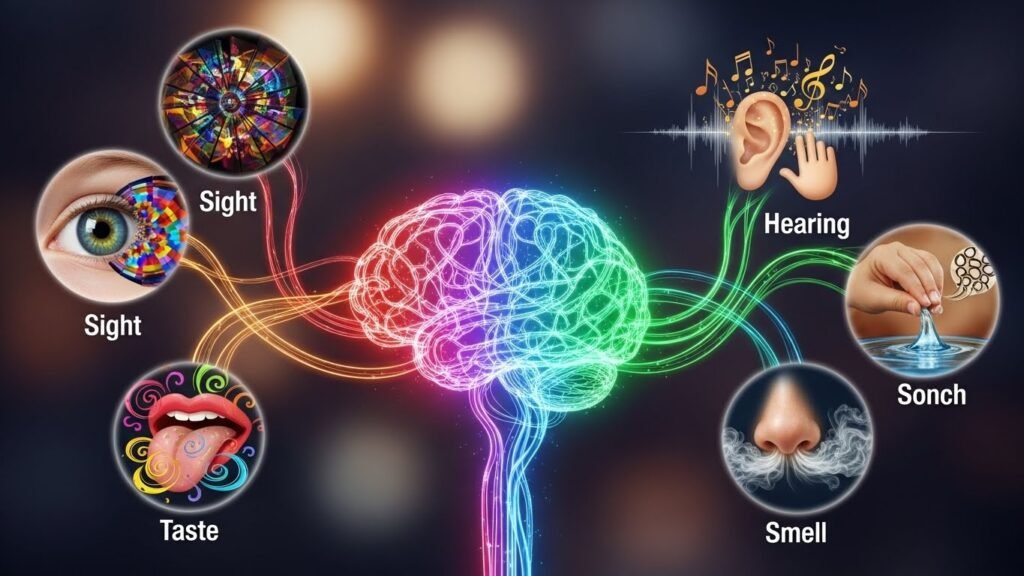
Sensory development strengthens your ability to perceive subtle intuitive signals that are often drowned out by the intense sensations created by fear.
While fear creates obvious physical symptoms – racing heart, sweating, muscle tension – intuition operates through much subtler channels.
By developing your sensory awareness, you can detect these gentle intuitive signals before they’re overwhelmed by fear’s dramatic presentations.
The practice involves systematically developing your five senses plus your subtle sensing abilities.
This might include practicing blind tasting to develop nuanced palate awareness, listening for subtle sounds in nature, feeling different textures with heightened attention, noticing subtle scent differences, or developing your “sixth sense” ability to feel energetic qualities in people and places.
These practices expand your perceptual range and increase sensitivity to intuitive information.
Research from neuroscience shows that sensory development literally changes brain structure, increasing gray matter density in areas associated with sensory processing and intuitive perception.
People who regularly practice sensory development show increased activity in the insula – the brain region associated with interoception (internal body awareness) and intuitive decision-making.
By developing your sensory capacities, you’re building the neurological foundation for enhanced Intuition vs. Fear awareness.
Key Takeaways:
- Sensory development perceives subtle intuitive signals drowned out by fear
- Intuition operates through subtler channels than fear’s obvious symptoms
- Systematic development of five senses plus subtle sensing abilities
- Expands perceptual range and increases sensitivity to intuitive information
- Literally changes brain structure for enhanced intuitive perception
8 Sensory Development Practices:
- Blind Tasting: Develop nuanced palate awareness without sight
- Nature Listening: Notice subtle sounds in natural environments
- Texture Exploration: Feel different materials with heightened attention
- Scent Discrimination: Identify subtle differences in aromas
- Energetic Sensing: Feel qualities in people and places
- Color Perception: Notice subtle shade differences and combinations
- Temperature Awareness: Detect slight temperature variations
- Vibration Sensing: Feel subtle energetic frequencies in environments
Technique #6: Pattern Recognition for Future Decisions {#pattern-recognition}
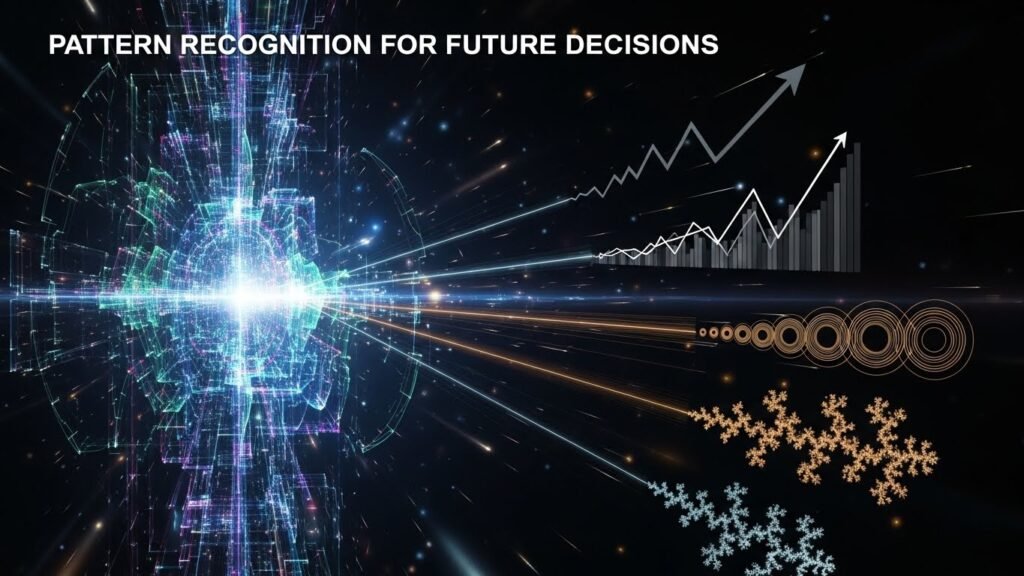
Pattern recognition involves developing your ability to notice recurring themes in how Intuition vs. Fear shows up in your life, enabling you to make better decisions in the future based on past experiences.
By tracking your decisions and their outcomes, you begin to notice your personal patterns – perhaps you consistently feel chest tightness when fear is driving, or you experience a calm certainty in your solar plexus when intuition is speaking.
These patterns become your personal guidance system.
The practice involves maintaining a decision journal where you record significant choices, the physical and emotional sensations you experienced while making them, and the eventual outcomes.
Over time, you’ll notice your unique intuitive signals and fear patterns, making future decisions clearer.
You might discover that your intuition often speaks through gentle physical sensations while fear creates mental loops of worst-case scenarios.
Research from cognitive psychology demonstrates that pattern recognition is one of the most powerful tools for improving decision-making accuracy.
People who regularly reflect on their decision-making patterns show significantly better intuition development and reduced decision-making anxiety.
By developing your personal pattern recognition system, you build a reliable internal guidance mechanism that becomes increasingly accurate over time.
Key Takeaways:
- Pattern recognition notices recurring themes in Intuition vs. Fear experiences
- Tracking decisions and outcomes reveals personal guidance patterns
- Personal patterns become reliable internal guidance system
- Decision journal records choices, sensations, and eventual outcomes
- Pattern recognition improves decision-making accuracy significantly
8 Pattern Recognition Practices:
- Decision Journal: Record significant choices and their outcomes
- Sensation Tracking: Note physical feelings during decision-making
- Outcome Analysis: Review which decisions led to satisfaction
- Pattern Mapping: Identify recurring intuitive/fear signals
- Accuracy Assessment: Track how often intuitive/fear predictions were correct
- Timing Recognition: Notice when intuition vs. fear typically appears
- Context Awareness: Identify situations where each is more likely
- Evolution Tracking: Notice how patterns change over time

Technique #7: Trust Building Exercises {#trust-building-exercises}
Trust building exercises are essential for developing Intuition vs. Fear awareness because many people have learned to distrust their inner guidance through years of conditioning.
Building trust involves starting with small, low-stakes decisions where you can practice following intuitive guidance and observing positive outcomes.
This creates positive reinforcement that strengthens your confidence in distinguishing between authentic guidance and fear-based thoughts.
The practice involves deliberately creating opportunities to practice intuitive decision-making in safe contexts.
This might include choosing which route to take home based on intuitive feelings, selecting restaurants based on gut instincts, or making small purchases based on inner guidance rather than over-analysis.
As you observe positive outcomes from following intuition, you build the evidence base that strengthens your trust in your inner guidance system.
Research from behavioral psychology shows that trust develops through consistent positive experiences.
Each time you follow your intuition and experience a positive outcome, you strengthen the neural pathways associated with intuitive decision-making.
Conversely, each time you override intuition with fear-based analysis and regret the decision, you weaken those pathways.
By consciously creating trust-building experiences, you accelerate the development of reliable Intuition vs. Fear awareness.
Key Takeaways:
- Trust building essential due to years of conditioning against inner guidance
- Start with small, low-stakes decisions for practice opportunities
- Positive reinforcement strengthens confidence in distinguishing signals
- Trust develops through consistent positive experiences
- Conscious trust-building accelerates reliable awareness development
8 Trust Building Exercises:
- Route Intuition: Choose driving routes based on gut feeling
- Restaurant Selection: Pick dining options based on inner guidance
- Small Purchases: Make minor purchases without over-analysis
- Social Intuition: Trust first impressions about people
- Creative Intuition: Follow creative impulses without judgment
- Timing Trust: Act on intuitive timing sense
- Saying No: Decline invitations based on inner knowing
- Opportunity Recognition: Notice and act on intuitive opportunities

Technique #8: Emotional Regulation for Clear Intuition {#emotional-regulation}
Emotional regulation is crucial for developing Intuition vs. Fear awareness because intense emotions can cloud both signals, making it difficult to distinguish between them.
When you’re overwhelmed by anger, sadness, excitement, or anxiety, your ability to perceive subtle intuitive signals becomes compromised.
Learning to regulate your emotional state creates the clear inner space necessary for accurate intuitive perception and fear recognition.
The practice involves developing skills to modulate emotional intensity without suppressing emotions entirely.
This might include breathing techniques to calm physiological arousal, mindfulness practices to create space between stimulus and response, or cognitive techniques to challenge catastrophic thinking that amplifies fear.
The goal is emotional balance – feeling fully while maintaining the clarity necessary for accurate intuitive perception.
Research from emotional intelligence studies shows that people with strong emotional regulation skills make better decisions, have stronger relationships, and experience less anxiety.
They’re better able to distinguish between genuine intuitive warnings and fear-based reactions because they can maintain clarity even during emotional intensity.
By developing emotional regulation skills, you create the optimal internal environment for reliable Intuition vs. Fear awareness.
Key Takeaways:
- Intense emotions cloud both intuitive signals and fear recognition
- Emotional regulation creates clear inner space for accurate perception
- Involves modulating intensity without suppressing emotions entirely
- Goal is emotional balance while maintaining clarity
- Strong regulation skills improve decision-making and reduce anxiety
8 Emotional Regulation Techniques:
- Breath Modulation: Use breathing to calm physiological arousal
- Mindful Pausing: Create space between stimulus and response
- Cognitive Reframing: Challenge catastrophic thinking patterns
- Emotional Labeling: Name emotions to reduce their intensity
- Body Awareness: Notice where emotions manifest physically
- Perspective Shifting: Zoom out to see bigger picture
- Self-Soothing: Use comforting techniques during distress
- Boundary Setting: Protect yourself from emotional overwhelm
Creating Your Daily Intuition vs. Fear Practice {#daily-practice}
Establishing a daily Intuition vs. Fear awareness practice requires a different approach than traditional self-improvement routines.
Instead of trying to eliminate fear or force intuition, you develop the habit of regularly checking in with your inner guidance system and distinguishing between authentic signals and fear-based noise.
This daily practice becomes increasingly natural as you develop sensitivity to your unique intuitive language and fear patterns.
Many practitioners find that morning intuition check-ins create the foundation for Intuition vs. Fear awareness throughout the day.
Starting your morning by asking “What does my intuition want me to know today?” and “What fears might cloud my judgment?” establishes a consciousness pattern that continues throughout your day.
You naturally begin checking in with yourself before important decisions, distinguishing between guidance and anxiety, and making choices from clarity rather than confusion.
Key Takeaways:
- Develop habit of regularly checking inner guidance system
- Choose one resonant technique and practice consistently before adding others
- Master one technique builds confidence and sensitivity for others
- Morning check-ins create foundation for daily awareness
- Natural checking becomes habit throughout day
8 Steps for Daily Practice Creation:
- Learning Style Assessment: Choose technique matching your learning preference
- Morning Check-In: Begin day with intuition and fear awareness questions
- Consistent Timing: Practice at same time daily for habit formation
- Decision Moments: Use techniques before important choices
- Evening Reflection: Review day’s intuitive/fear-based decisions
- Progress Tracking: Notice improvements in decision-making quality
- Pattern Recognition: Identify your unique intuitive/fear signals
- Natural Integration: Allow awareness to become automatic habit
Common Mistakes and How to Avoid Them {#common-mistakes}
Even with powerful techniques for Intuition vs. Fear awareness, certain mistakes can derail your development.
The most common error is what practitioners call “intuition perfectionism” – expecting your intuitive signals to be 100% clear and accurate immediately.
This creates pressure that actually blocks intuitive flow and increases fear-based second-guessing. Developing intuitive awareness is like learning any skill – it takes time, practice, and patience with your learning curve.
The “comparison trap” derails many people by creating unrealistic expectations about how intuition should work based on others’ experiences or cultural stereotypes.
Some people expect dramatic visions or thunderbolt clarity, then feel inadequate when their intuition shows up as gentle knowing or physical sensations.
Understanding that intuitive awareness develops uniquely for each person helps you honor your natural style rather than trying to force someone else’s experience.
Key Takeaways:
- Intuition perfectionism creates pressure blocking intuitive flow
- Fear suppression eliminates important protective function
- Goal is distinguishing fear from intuition, not eliminating fear
- Comparison trap creates unrealistic expectations about intuitive development
- Understanding unique development honors natural style
8 Common Mistakes to Avoid:
- Perfectionism Expectation: Expecting 100% clarity immediately
- Fear Elimination: Trying to get rid of fear entirely
- Comparison Judging: Comparing your development to others’
- Force Attempt: Trying to force intuitive experiences
- Impatience: Becoming discouraged with gradual development
- External Reliance: Depending too much on others’ validation
- Dismissal Habit: Ignoring intuitive signals when they’re subtle
- Overthinking: Analyzing intuitive feelings rather than experiencing them
📊 The Complete Intuition vs. Fear Framework {#comparison-table}
| Aspect | Intuition Signal | Fear Signal | Physical Sensation | Decision Quality | Long-term Reliability |
|---|---|---|---|---|---|
| Quality | Calm knowing | Urgent anxiety | Expansion vs. contraction | Clear direction | Highly reliable |
| Timing | Timeless patience | Immediate demand | Gradual vs. sudden | Patient clarity | Consistent over time |
| Voice | Quiet confidence | Loud alarm | Gentle vs. jarring | Confident choice | Trust-building |
| Body | Relaxed openness | Tense closure | Open vs. tight | Grounded decision | Physically aligned |
| Mind | Clear simplicity | Complex loops | Simple vs. complicated | Straightforward | Mentally calming |
| Energy | Grounded presence | Agitated restlessness | Centered vs. scattered | Centered choice | Energizing |
| Outcome | Satisfying regardless | Relief only if “safe” | Peace vs. tension | Fulfilling path | Life-enhancing |
| Development | Strengthens with use | Diminishes with awareness | Increases vs. decreases | Improves over time | Skill-building |
💫 Real Transformation Stories {#transformation-stories}
Michael’s Career Breakthrough: A marketing executive who’d been paralyzed by fear of leaving his corporate job, Michael learned to distinguish between his intuition and anxiety through body awareness scanning. “I realized my fear created chest tightness and racing thoughts about financial disaster,” he shares. “My intuition felt like a calm knowing that I was ready for something new. Once I trusted that calm signal, I left my job and started my own consulting business. Within a year, I was earning more while doing work I love.”
Jennifer’s Relationship Clarity: Struggling with whether to stay in a comfortable but unfulfilling relationship, Jennifer used timing recognition and inner voice clarity techniques. “My fear created urgent pressure to decide immediately and catastrophic thoughts about being alone forever,” she explains. “My intuition felt like patient clarity that I deserved more. Learning to wait for that calm knowing gave me the courage to leave. Six months later, I met someone who truly aligns with my values.”
❓ Frequently Asked Questions About Intuition vs. Fear {#faqs}
Q1: How do I know if I’m really hearing my intuition or just wishful thinking?A: Intuition often feels calm and clear even when delivering challenging messages, while wishful thinking tends to create excitement and attachment to specific outcomes. True intuition maintains its steady quality regardless of whether the guidance is easy or difficult to follow.
Q2: Can my intuition be wrong?A: Intuition operates based on your accumulated experience and deep wisdom, making it highly reliable for your personal decisions. However, it’s important to distinguish between intuition (calm knowing) and fear disguised as intuition (urgent anxiety). With practice, your accuracy improves significantly.
Q3: What if my fear is based on real past experiences?A: Valid fear based on past experiences deserves acknowledgment and appropriate action. However, learning to distinguish between protective fear (genuine warning) and limiting fear (unnecessary restriction) helps you respond appropriately while still accessing intuitive guidance for growth and expansion.
Q4: How long does it take to develop strong Intuition vs. Fear awareness?A: Most people notice improvement within 2-3 weeks of consistent practice, but developing mastery is an ongoing journey. Like any skill, it strengthens with use. Start with daily awareness practices and gradually build your capacity for distinguishing between signals.
Q5: Can anxiety or depression affect my ability to access intuition?A: While anxiety and depression can cloud intuition, developing awareness skills actually helps manage these conditions. The practices for distinguishing intuition from fear also help regulate anxiety and improve overall mental health. Work with mental health professionals while developing these skills.
Q6: Is it possible to have too much intuition?A: Authentic intuition is naturally balanced and doesn’t create overwhelm. However, some people confuse hypervigilance or anxiety sensitivity with intuition. True intuition feels grounding and clarifying rather than overwhelming or exhausting.
Q7: How do I use intuition in relationships without getting hurt?A: Intuition in relationships helps you recognize alignment and potential challenges early. It doesn’t guarantee pain-free experiences but helps you make choices that honor your authentic needs and values. Use these skills alongside healthy relationship practices and communication.
Q8: What’s the difference between intuition and psychic abilities?A: Intuition is a natural human capacity for accessing deep wisdom and pattern recognition. Psychic abilities are extensions of intuition that may include sensing information beyond normal perception. Both operate through similar mechanisms, but intuition is accessible to everyone while psychic abilities vary among individuals.
Q9: Can children learn to distinguish between intuition and fear?A: Children often have strong natural intuition but may lack the vocabulary to distinguish it from fear. Teaching them body awareness and emotional regulation helps them develop these skills early. Use age-appropriate language and exercises to help them trust their inner wisdom.
Q10: How do I balance intuition with logical thinking?A: Intuition and logic work best together as complementary decision-making tools. Use intuition to sense what feels right, then apply logic to evaluate practical considerations. The goal is integration rather than choosing one over the other – let each inform different aspects of your decision-making process.
🌟 Your Journey to Intuitive Clarity Begins Now {#conclusion}
You’ve just discovered 8 powerful techniques for developing Intuition vs. Fear awareness that can transform every decision you make. These aren’t just theoretical concepts – they’re practical tools that thousands have used to develop unshakeable trust in their inner guidance while managing the anxiety that once controlled their choices.
The beautiful truth about intuition: It’s not something you need to develop from scratch – it’s a natural capacity you’ve always possessed that simply needs recognition and refinement. Like a muscle that’s been underused, your intuition strengthens with consistent practice and patient attention. The techniques you’ve learned here simply help you distinguish between your authentic inner wisdom and the fear-based thoughts that have been masquerading as guidance.
Your transformation timeline starts today:
- This week: Choose one technique and practice it daily for 5-10 minutes
- This month: Notice how your decision-making confidence improves and anxiety decreases
- This year: Experience the compound effect of making choices from intuitive clarity rather than fear-based confusion
The path forward requires courage and patience:
- Start small: Practice with low-stakes decisions before tackling major life choices
- Stay consistent: Daily practice builds the neural pathways for reliable intuition
- Trust the process: Your inner wisdom knows exactly how to guide you
- Be patient: Like any skill, intuition strengthens gradually with dedicated practice
Remember: You don’t need to eliminate fear to access intuition – you simply need to learn its language so you can distinguish between genuine warnings and anxiety-based interference. When you master Intuition vs. Fear awareness, you don’t just make better decisions – you live with the confidence that comes from being guided by your authentic inner wisdom.
Take the first breath. Ask your first question. Listen for the quiet knowing that has always been there.
Your journey from fear-based confusion to intuitive clarity begins with that first conscious choice to listen within. Your authentic guidance is waiting to be heard. 🌟
Happy intuiting – from a place of clarity and confidence! ✨