
📋 Table of Contents
- Understanding Surrender vs. Giving Up: The Fundamental Difference
- The Psychology Behind Surrender: Why Acceptance Creates Power
- The Defeat of Giving Up: How Hopelessness Takes Root
- Reason #1: Surrender Creates Peace vs. Giving Up Creates Despair
- Reason #2: Surrender Maintains Personal Power vs. Giving Up Relinquishes It
- Reason #3: Surrender Opens New Possibilities vs. Giving Up Closes Doors
- Reason #4: Surrender Aligns with Wisdom vs. Giving Up Stems from Fear
- Reason #5: Surrender Builds Resilience vs. Giving Up Creates Learned Helplessness
- Reason #6: Surrender Attracts Support vs. Giving Up Isolates You
- Reason #7: Surrender Leads to Growth vs. Giving Up Stops Evolution
- Reason #8: Surrender Feels Liberating vs. Giving Up Feels Trapped
- Practical Applications: When to Surrender vs. When to Keep Fighting
- The Complete Surrender vs. Giving Up Framework
- Real Transformation Stories
- Frequently Asked Questions
- Your Journey from Giving Up to Surrender Begins Now
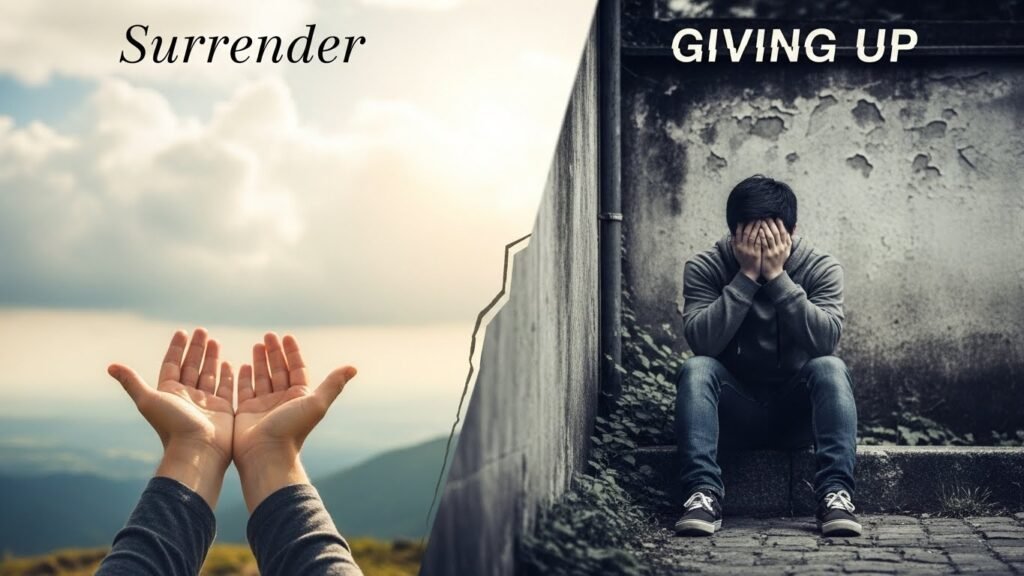
Understanding Surrender vs. Giving Up: The Fundamental Difference {#understanding-difference}
The distinction between surrender vs. giving up represents one of the most profound yet misunderstood concepts in personal development psychology.
Surrender is an active, empowering choice to accept what you cannot change while maintaining your inner power and openness to new possibilities.
Giving up is a passive, disempowering state where you relinquish your agency and close yourself off from potential opportunities, often stemming from fear, exhaustion, or hopelessness.
Surrender operates from a place of wisdom and strength – it’s the recognition that you’ve done what you can and now it’s time to allow life to unfold naturally.
This doesn’t mean becoming passive or resigned; rather, it’s about releasing the illusion of control over outcomes while maintaining your power to choose your response.
Giving up, conversely, stems from a place of defeat and disempowerment. It’s the belief that you have no options, no power, and no hope for improvement.
This mindset triggers stress responses in the brain that actually impair cognitive function and decision-making abilities, creating a self-perpetuating cycle of helplessness that can be difficult to break without conscious intervention.
Key Takeaways:
- Surrender is active and empowering; giving up is passive and disempowering
- Surrender maintains inner power while releasing outcome control
- Giving up stems from defeat and closes off possibilities
- Surrender activates resilience pathways; giving up triggers stress responses
- Understanding this difference is crucial for personal transformation
8 Core Differences Between Surrender and Giving Up:
- Energy State: Surrender feels peaceful; giving up feels exhausting
- Mindset: Surrender operates from wisdom; giving up from fear
- Power Dynamic: Surrender maintains agency; giving up relinquishes it
- Future Orientation: Surrender remains open; giving up closes possibilities
- Emotional Quality: Surrender creates calm; giving up creates despair
- Action Orientation: Surrender allows flow; giving up creates stagnation
- Self-Perception: Surrender honors worth; giving up diminishes it
- Outcome Impact: Surrender attracts support; giving up isolates you
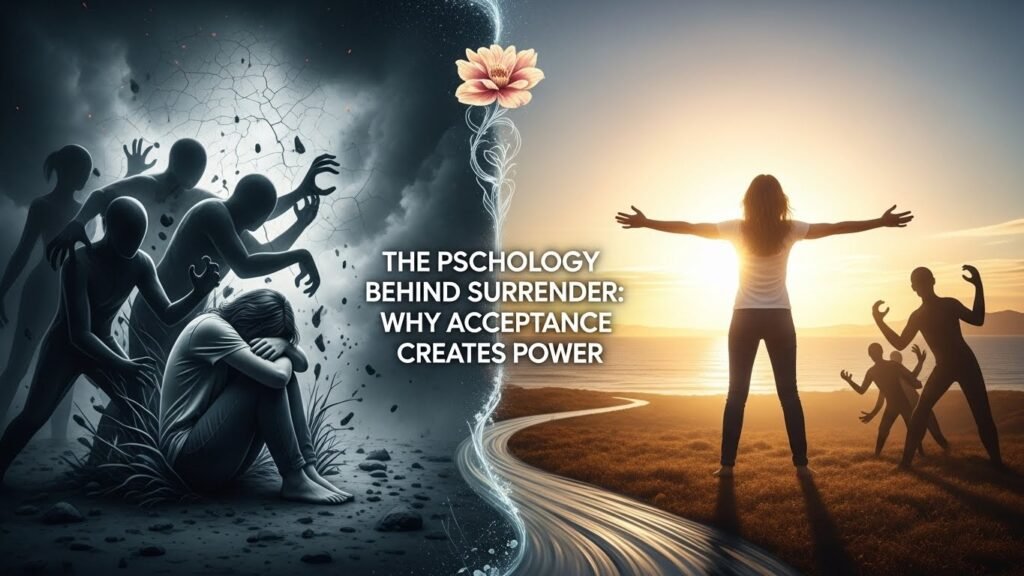
The Psychology Behind Surrender: Why Acceptance Creates Power {#psychology-surrender}
The psychology behind surrender reveals why this practice creates genuine personal power rather than the weakness many associate with “giving up.”
Surrender activates what researchers call “psychological flexibility” – the ability to adapt to changing circumstances while maintaining core values and purpose.
This flexibility is associated with better mental health outcomes, increased resilience, and enhanced creative problem-solving abilities.
When you practice surrender, your brain shifts from the stress-inducing fight-or-flight response to the rest-and-digest parasympathetic nervous system activation.
This physiological shift allows for clearer thinking, better emotional regulation, and access to creative solutions that aren’t available when you’re in survival mode.
Studies from Harvard Medical School demonstrate that acceptance-based practices like surrender can reduce cortisol levels by up to 23% while improving cognitive function.
Surrender also engages what psychologists term “radical acceptance” – the ability to acknowledge reality without judgment or resistance.
By accepting what you cannot change, you free mental and emotional energy to focus on what you can influence, leading to more effective and efficient responses to life’s challenges.
Key Takeaways:
- Surrender activates psychological flexibility and adaptive responses
- Brain shifts from stress response to parasympathetic activation
- Acceptance practices reduce cortisol and improve cognitive function
- Radical acceptance creates space for meaningful action
- Psychological power comes from focusing energy on what you can influence
8 Psychological Benefits of Surrender:
- Stress Reduction: Activates parasympathetic nervous system response
- Clarity Enhancement: Reduces cognitive fog from resistance
- Emotional Regulation: Improves ability to process difficult emotions
- Creative Problem-Solving: Accesses solutions unavailable in survival mode
- Resilience Building: Strengthens adaptability to change
- Energy Conservation: Frees resources from fruitless resistance
- Self-Compassion: Increases kindness toward yourself
- Present-Moment Awareness: Enhances ability to respond effectively

The Defeat of Giving Up: How Hopelessness Takes Root {#defeat-giving-up}
Giving up represents a profound psychological defeat that extends far beyond simply stopping an activity.
When you give up, you’re not just abandoning an external goal – you’re abandoning hope, agency, and your belief in your own capacity to influence your life.
This creates what psychologists call “learned helplessness,” a condition where you believe you have no control over your circumstances, leading to depression, anxiety, and decreased motivation.
The neuroscience of giving up reveals that this state activates the brain’s default mode network in ways that reinforce negative thought patterns.
When you give up, your brain begins to generate evidence supporting your helplessness, creating a self-reinforcing cycle of defeat that becomes increasingly difficult to break.
Research from Stanford University shows that learned helplessness can actually alter brain structure, reducing gray matter density in areas associated with motivation and decision-making.
Giving up also creates what researchers term “identity foreclosure” – the premature closing off of possibilities for growth and change.
When you give up on something meaningful, you often give up on parts of yourself that were invested in that goal or dream.
Key Takeaways:
- Giving up represents abandonment of hope, agency, and self-belief
- Creates learned helplessness leading to depression and anxiety
- Activates brain networks that reinforce negative thought patterns
- Alters brain structure reducing motivation and decision-making capacity
- Creates identity foreclosure and cascading life limitations
8 Psychological Consequences of Giving Up:
- Learned Helplessness: Belief in lack of control over circumstances
- Depression Risk: Increased vulnerability to depressive episodes
- Identity Foreclosure: Premature closing off of growth possibilities
- Self-Efficacy Loss: Decreased belief in personal capability
- Motivation Reduction: Diminished drive to pursue goals
- Brain Structure Changes: Reduced gray matter in motivation areas
- Negative Thought Reinforcement: Self-perpetuating defeat cycles
- Life Narrowing: Progressively diminished experience of possibilities
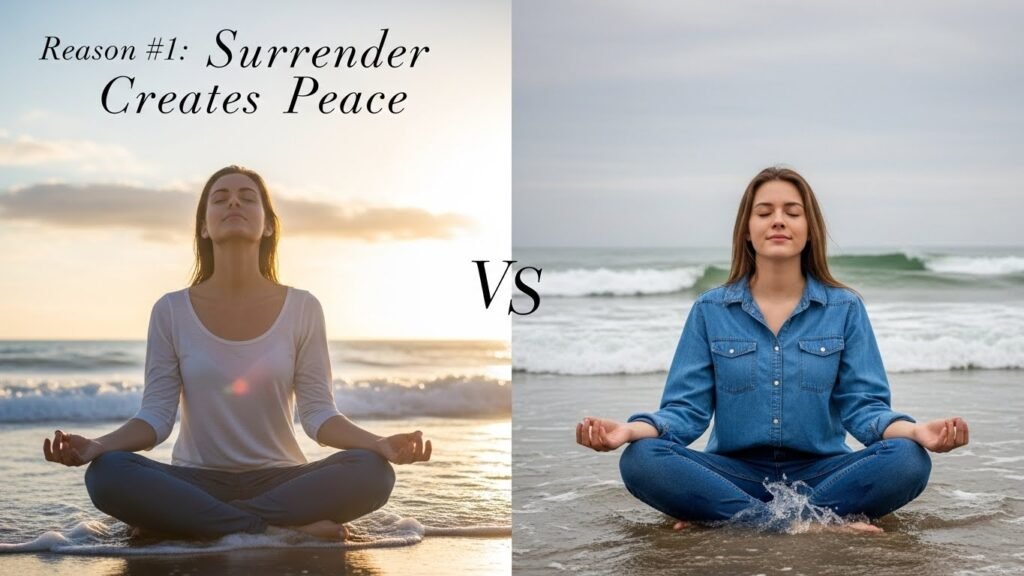
Reason #1: Surrender Creates Peace vs. Giving Up Creates Despair {#reason-1-peace-vs-despair}
The first fundamental difference between surrender vs. giving up lies in their emotional impact: surrender creates profound inner peace while giving up generates deep despair.
When you surrender, you experience what researchers call “post-surrender peace” – a state of calm acceptance that comes from releasing the exhausting struggle against reality.
This peace isn’t passive resignation but active contentment that emerges from aligning with what is rather than fighting what cannot be changed.
This creates space for what psychologists term “radical acceptance” – the ability to embrace reality without resistance.
Studies from the University of California show that people who practice surrender experience significantly lower cortisol levels and report higher life satisfaction compared to those who continue struggling against unchangeable circumstances.
Giving up, conversely, creates a special kind of despair that comes from abandoning hope itself.
This isn’t just sadness about a specific outcome – it’s the deeper pain of believing that nothing better is possible for you.
This despair often manifests as a heavy, suffocating feeling that colors every aspect of life, creating what therapists call “global hopelessness” that extends far beyond the specific situation where you gave up.
Key Takeaways:
- Surrender creates post-surrender peace through releasing struggle
- Peace emerges from aligning with reality rather than fighting it
- Surrender lowers cortisol and increases life satisfaction
- Giving up creates global hopelessness extending beyond specific situations
- Despair from giving up is deeper than sadness about outcomes
8 Ways Peace Through Surrender Manifests:
- Inner Calm: Quiet contentment regardless of external circumstances
- Acceptance Energy: Alignment with what is rather than resistance
- Sleep Improvement: Better rest without mental struggle
- Clarity Emergence: Clear thinking without emotional fog
- Energy Conservation: Resources freed from fruitless fighting
- Present Moment Joy: Ability to find happiness in what exists
- Relationship Harmony: Reduced conflict with others over unchangeable situations
- Spiritual Connection: Deeper sense of meaning and purpose
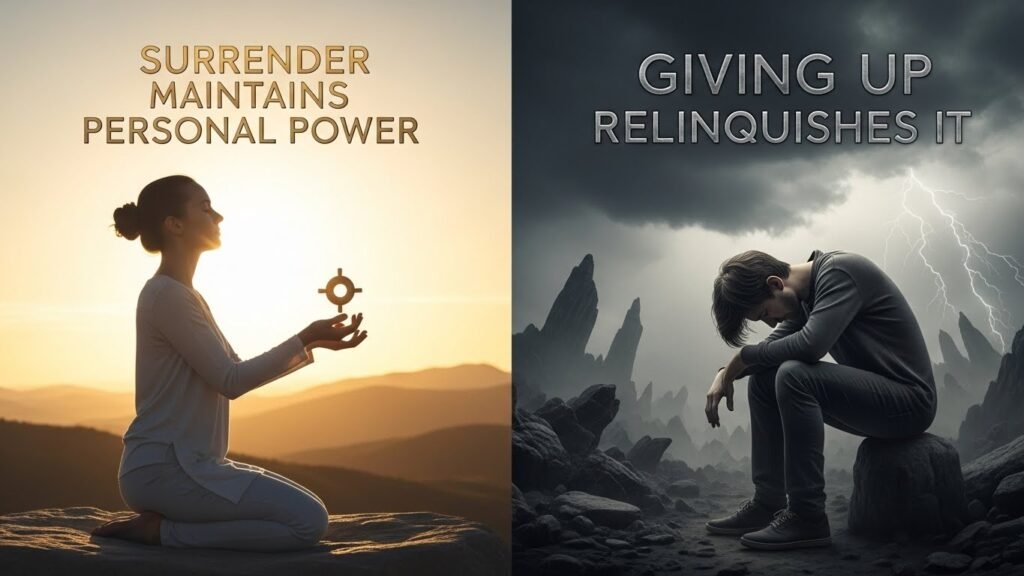
Reason #2: Surrender Maintains Personal Power vs. Giving Up Relinquishes It {#reason-2-power-vs-relinquishment}
The second crucial distinction lies in power dynamics: surrender maintains and even enhances your personal power while giving up completely relinquishes it.
When you surrender, you make a conscious choice to release control over outcomes while maintaining full authority over your responses, attitudes, and actions.
This distinction is crucial – you’re not becoming powerless; you’re choosing where to direct your power most effectively.
Surrender actually increases your personal power by freeing you from the exhausting burden of trying to control the uncontrollable.
This energy can then be redirected toward areas where you do have influence – your personal growth, your responses to challenges, your attitude toward circumstances, and your choices about how to move forward.
Research from positive psychology shows that this internal locus of control is strongly correlated with resilience, life satisfaction, and overall wellbeing.
Giving up, however, involves surrendering your agency entirely. It’s not just releasing control over outcomes – it’s abandoning your authority over your own responses and choices.
This belief becomes self-fulfilling, creating a cycle where you stop trying because you believe trying is futile, which then provides evidence that trying is indeed futile.
Key Takeaways:
- Surrender maintains authority over responses while releasing outcome control
- Power increases by freeing energy from uncontrollable situations
- Internal locus of control correlates with resilience and wellbeing
- Giving up abandons agency over responses and choices
- Learned helplessness creates self-fulfilling powerlessness cycles
8 Ways Surrender Maintains Personal Power:
- Response Authority: Maintain control over your reactions
- Attitude Choice: Choose your perspective on circumstances
- Energy Redirection: Focus power where it can be effective
- Boundary Setting: Decide what you will and won’t accept
- Value Alignment: Stay true to what matters most to you
- Growth Focus: Channel energy into personal development
- Choice Retention: Keep your options open for the future
- Self-Trust Building: Strengthen confidence in your decisions

Reason #3: Surrender Opens New Possibilities vs. Giving Up Closes Doors {#reason-3-possibilities-vs-closure}
The third profound difference lies in how each approach affects future possibilities: surrender opens new doors while giving up slams them shut.
When you surrender, you create space for possibilities you couldn’t see while focused on forcing a specific outcome.
This isn’t magical thinking – it’s the practical reality that releasing rigid expectations allows you to notice opportunities that were previously obscured by your attachment to how things “should” be.
Surrender creates what researchers call “cognitive flexibility” – the mental agility to see multiple options and adapt to changing circumstances.
When you’re no longer locked into a specific outcome, your brain can explore creative alternatives, notice subtle opportunities, and make connections that weren’t visible while you were forcing a particular result.
Studies show that people who practice surrender have increased activity in brain regions associated with creativity and innovation.
Giving up, conversely, creates psychological closure that prevents you from seeing or pursuing alternatives.
This creates what psychologists term “selective attention blindness” – you literally can’t see opportunities that exist because your mind has decided they’re impossible.
This isn’t just negative thinking; it’s a neurological state that prevents you from accessing options that might be available.
Key Takeaways:
- Surrender creates space for previously unseen possibilities
- Cognitive flexibility allows seeing multiple options and adapting
- Surrender increases brain activity in creativity and innovation regions
- Giving up creates psychological closure preventing option recognition
- Selective attention blindness prevents seeing existing opportunities
8 Ways Surrender Opens New Possibilities:
- Perceptual Expansion: Notice options previously overlooked
- Energy Liberation: Free resources for exploring alternatives
- Creative Activation: Access innovative solutions unavailable before
- Connection Recognition: See relationships between previously separate ideas
- Timing Flexibility: Allow events to unfold at their natural pace
- Resource Availability: Notice support that was previously ignored
- Pathway Revelation: Discover routes invisible while forcing outcomes
- Synchronicity Experience: Notice meaningful coincidences and timing
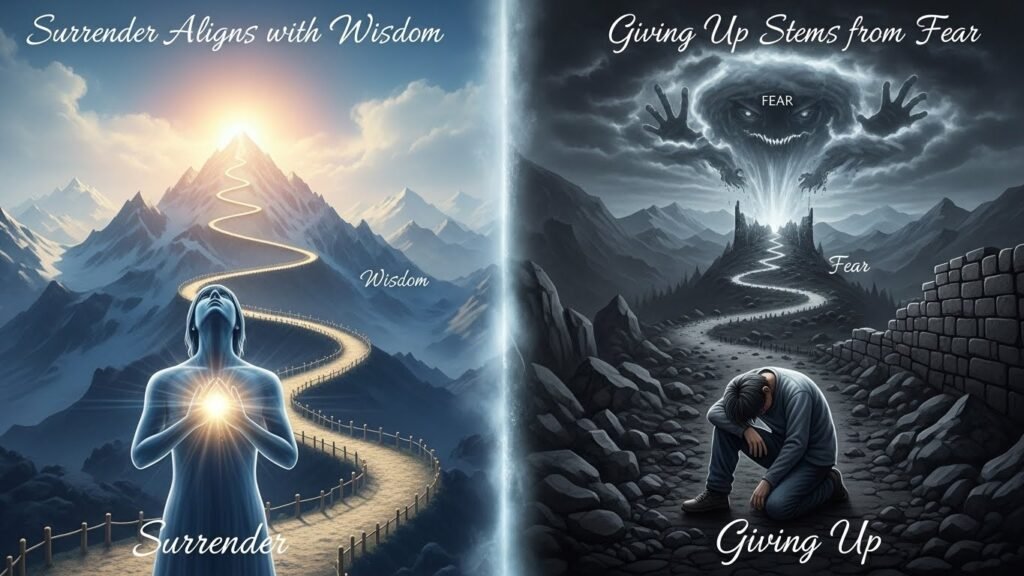
Reason #4: Surrender Aligns with Wisdom vs. Giving Up Stems from Fear {#reason-4-wisdom-vs-fear}
The fourth fundamental distinction lies in the source and motivation: surrender aligns with deep wisdom while giving up stems from primal fear.
Surrender emerges from a mature understanding of life’s limitations, the recognition of what truly matters, and the wisdom to distinguish between what you can and cannot control.
Surrender reflects what psychologists call “wisdom-based decision making” – choices that consider long-term consequences, multiple perspectives, and deeper values rather than immediate gratification or fear-based reactions.
Research from the University of Chicago shows that wisdom-based choices correlate with higher life satisfaction, better relationships, and improved mental health outcomes.
Giving up, conversely, originates from fear-based thinking that narrows your perspective and limits your options.
Fear triggers the amygdala’s threat response, creating tunnel vision that prevents you from seeing creative solutions or alternative paths forward.
This fear-based state literally impairs cognitive function, reducing your ability to think clearly, creatively, or compassionately.
Key Takeaways:
- Surrender emerges from mature understanding of life’s limitations
- Reflects wisdom-based decision making considering long-term consequences
- Wisdom-based choices correlate with higher life satisfaction and better outcomes
- Giving up originates from fear-based thinking that narrows perspective
- Fear impairs cognitive function and prevents seeing creative solutions
8 Wisdom Elements of Surrender vs. Fear Elements of Giving Up:
- Perspective: Long-term view vs. immediate threat focus
- Values Alignment: Considers deepest values vs. reacts to fear
- Clarity: Sees reality clearly vs. sees through fear filter
- Compassion: Includes self-compassion vs. self-criticism
- Acceptance: Acknowledges limitations vs. denies possibilities
- Patience: Allows natural timing vs. demands immediate resolution
- Trust: Trusts life process vs. distrusts everything
- Peace: Creates inner peace vs. generates anxiety
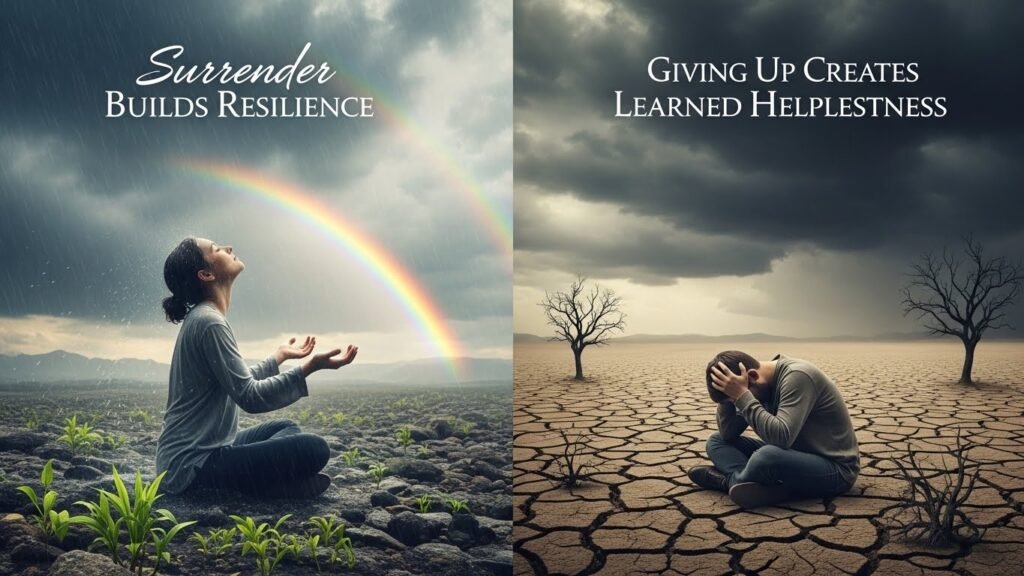
Reason #5: Surrender Builds Resilience vs. Giving Up Creates Learned Helplessness {#reason-5-resilience-vs-helplessness}
The fifth crucial difference lies in how each approach affects your psychological resilience: surrender builds your capacity to handle future challenges while giving up creates learned helplessness that undermines future coping ability.
Surrender strengthens what psychologists call “psychological flexibility” – your ability to adapt to changing circumstances while maintaining core stability.
This flexibility is one of the strongest predictors of long-term mental health and life satisfaction.
When you practice surrender, you’re essentially training your nervous system to handle uncertainty and change without becoming overwhelmed.
Research from resilience studies shows that people who practice acceptance-based coping (like surrender) have significantly better outcomes when facing future adversities.
Giving up, however, creates what researchers call “learned helplessness” – the psychological state where you believe you have no control over outcomes, leading to decreased motivation, impaired problem-solving, and increased vulnerability to depression.
Each time you give up, you reinforce the belief that you’re powerless, making it more likely that you’ll give up again in the future.
This creates a downward spiral where your capacity to handle challenges actually decreases over time.
Key Takeaways:
- Surrender builds psychological flexibility and adaptation capacity
- Each surrender experience strengthens ability to handle future challenges
- Resilience research shows acceptance-based coping predicts better outcomes
- Giving up creates learned helplessness that undermines future coping
- Learned helplessness creates downward spiral of decreasing capacity
8 Resilience Benefits of Surrender vs. Helplessness Consequences of Giving Up:
- Adaptation Capacity: Increases flexibility vs. decreases adaptability
- Stress Tolerance: Builds tolerance vs. reduces tolerance
- Problem-Solving: Enhances creativity vs. impairs solutions
- Emotional Regulation: Strengthens regulation vs. weakens control
- Self-Efficacy: Builds confidence vs. undermines belief
- Future Orientation: Maintains hope vs. creates hopelessness
- Resource Management: Conserves energy vs. wastes resources
- Growth Integration: Transforms challenges vs. avoids growth
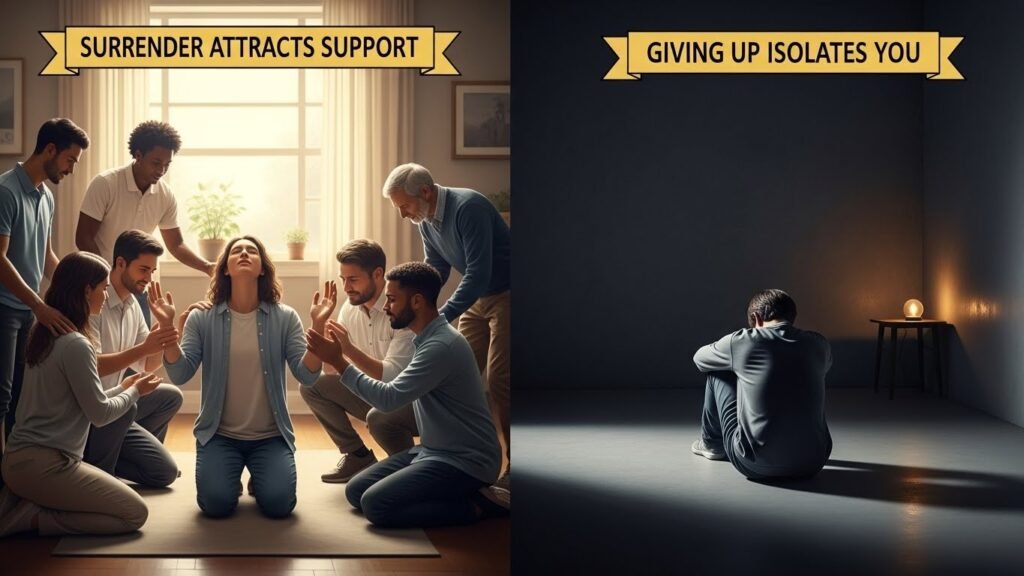
Reason #6: Surrender Attracts Support vs. Giving Up Isolates You {#reason-6-support-vs-isolation}
The sixth profound distinction lies in how each approach affects your relationships and support systems: surrender naturally attracts support and connection while giving up pushes people away and creates isolation.
When you surrender with grace and dignity, you create space for others to support you in meaningful ways.
Your acceptance of reality allows others to be present with you without feeling helpless or overwhelmed by your resistance.
Surrender creates what researchers call “authentic vulnerability” – the ability to be real about your struggles while maintaining your strength and dignity.
This type of vulnerability actually strengthens relationships because it allows for genuine connection and mutual support.
People are naturally drawn to those who handle challenges with grace, and they want to help and support those who are accepting their situation with wisdom rather than fighting against it with desperation.
Giving up, conversely, creates what psychologists term “toxic vulnerability” – a state where your hopelessness and despair make others feel helpless and overwhelmed.
When you give up, you often radiate hopelessness that can be emotionally draining for those around you.
This doesn’t mean you shouldn’t share your struggles, but giving up creates a dynamic where others feel they can’t help you, leading to emotional distance and eventual isolation.
Key Takeaways:
- Surrender creates authentic vulnerability that strengthens relationships
- Acceptance allows others to support meaningfully without feeling helpless
- Graceful surrender attracts support and connection naturally
- Giving up creates toxic vulnerability that overwhelms others
- Hopelessness from giving up pushes people away emotionally
8 Ways Surrender Attracts Support vs. How Giving Up Creates Isolation:
- Authentic Vulnerability: Creates genuine connection vs. overwhelming others
- Energy Conservation: Preserves relational energy vs. draining others
- Dignity Maintenance: Maintains personal dignity vs. appearing defeated
- Hope Preservation: Keeps hope alive vs. spreading hopelessness
- Mutual Empowerment: Creates mutual support vs. one-sided relationships
- Emotional Safety: Makes others feel safe vs. creating emotional risk
- Inspiration Factor: Inspires others vs. depressing them
- Community Building: Builds connection vs. breaking bonds
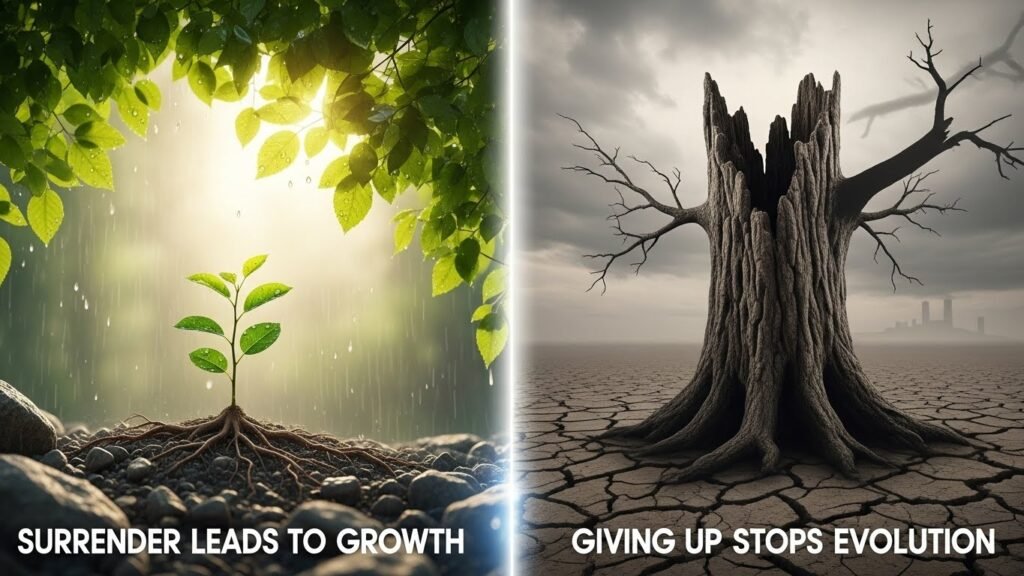
Reason #7: Surrender Leads to Growth vs. Giving Up Stops Evolution {#reason-7-growth-vs-stagnation}
The seventh fundamental difference lies in personal evolution: surrender catalyzes profound growth while giving up creates stagnation.
This process of expansion through acceptance leads to what psychologists call “post-traumatic growth” – positive psychological change that occurs through struggling with challenging circumstances.
Surrender catalyzes growth by pushing you beyond your comfort zone and requiring you to develop new skills, perspectives, and capacities.
When you surrender to a challenging situation, you’re forced to develop emotional resilience, spiritual depth, creative problem-solving, and wisdom that wouldn’t have developed otherwise.
Research from post-traumatic growth studies shows that people who practice acceptance-based coping (like surrender) often report increased personal strength, deeper appreciation for life, and enhanced spiritual development.
Giving up, however, stops personal evolution because it involves closing yourself off from growth opportunities.
When you give up, you stop trying, stop learning, and stop developing.
This creates what researchers term “psychological stagnation” – a state where personal growth ceases and life becomes increasingly narrow and limited.
Key Takeaways:
- Surrender catalyzes profound personal growth and evolution
- Requires expansion beyond previous limitations and capacity development
- Leads to post-traumatic growth through struggling with challenges
- Giving up creates psychological stagnation and stops evolution
- Decision to give up becomes turning point where growth stops
8 Growth Aspects of Surrender vs. Stagnation Results of Giving Up:
- Resilience Building: Develops emotional strength vs. weakens coping ability
- Wisdom Development: Gains life understanding vs. stops learning
- Capacity Expansion: Increases abilities vs. limits development
- Perspective Broadening: Sees bigger picture vs. narrows viewpoint
- Spiritual Deepening: Develops spiritual maturity vs. shallow existence
- Compassion Growth: Increases empathy vs. becomes self-focused
- Strength Discovery: Finds inner resources vs. loses self-belief
- Evolution Acceleration: Speeds up development vs. stops progress
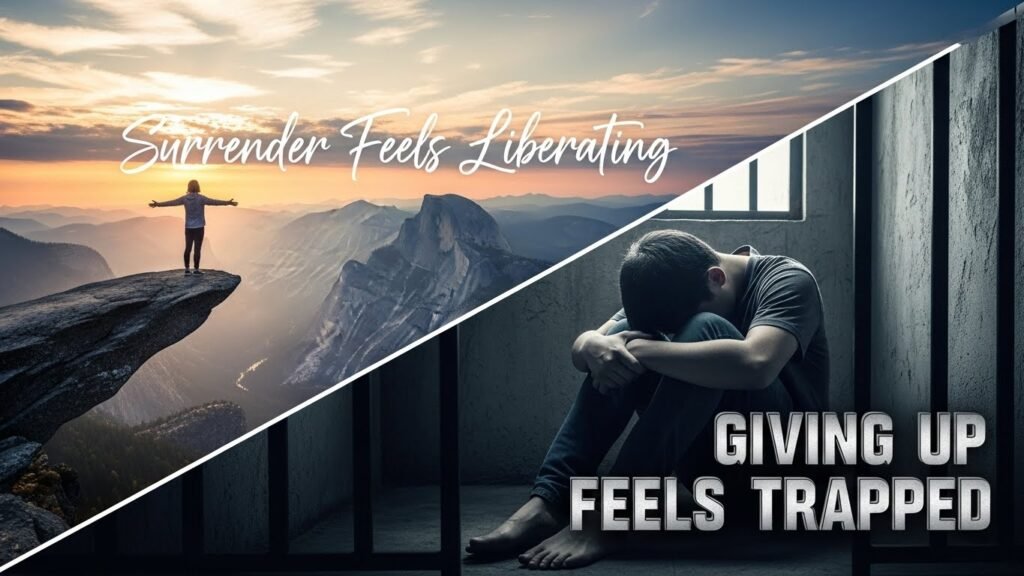
Reason #8: Surrender Feels Liberating vs. Giving Up Feels Trapped {#reason-8-liberation-vs-trapped}
The eighth and perhaps most immediately noticeable difference lies in the emotional experience: surrender feels liberating while giving up feels trapped.
When you truly surrender, you experience what can only be described as “liberation through letting go” – the profound freedom that comes from releasing the exhausting burden of trying to control the uncontrollable.
This liberation isn’t just mental; it’s a full-body experience of relief, peace, and expanded possibility.
This liberation occurs because surrender releases you from the psychological prison of resistance.
When you stop fighting against reality and start working with it, you experience the physical and emotional relief that comes from dropping the heavy burden of “shoulds,” “musts,” and “have tos.”
Research from stress physiology shows that this release creates measurable changes in the body – cortisol levels drop, muscle tension releases, and the entire nervous system shifts from fight-or-flight to rest-and-digest mode.
Giving up, conversely, creates the psychological experience of being trapped – caught in circumstances you can’t change with no hope for improvement.
This trapped feeling creates a different kind of stress – the chronic, grinding anxiety that comes from believing you’re stuck with no options.
Unlike the acute stress of struggle, this chronic stress of hopelessness is actually more damaging to physical and mental health, leading to increased risk of depression, anxiety disorders, and stress-related physical illnesses.
Key Takeaways:
- Surrender creates liberation through releasing control burden
- Full-body experience of relief, peace, and expanded possibility
- Releases from psychological prison of resistance
- Creates measurable physiological changes including stress reduction
- Giving up creates trapped feeling with chronic hopelessness stress
8 Liberation Aspects of Surrender vs. Trapped Experience of Giving Up:
- Physical Relief: Muscle tension releases vs. chronic stress builds
- Mental Freedom: Thoughts become clear vs. mind feels trapped
- Emotional Release: Feelings flow naturally vs. emotions feel stuck
- Energy Liberation: Resources become available vs. energy feels blocked
- Breathing Deepening: Breath deepens naturally vs. breathing becomes shallow
- Perspective Expansion: View broadens vs. vision narrows
- Peace Experience: Inner peace emerges vs. inner turmoil continues
- Joy Return: Natural joy returns vs. joy disappears
Practical Applications: When to Surrender vs. When to Keep Fighting {#practical-applications}
Understanding when to surrender vs. when to keep fighting is crucial for applying these concepts effectively in your life.
Surrender isn’t appropriate for every situation – there are times when persistence, effort, and fighting for what you believe in are absolutely the right choices.
The decision framework involves assessing several factors: whether you’ve genuinely done what you can to influence the outcome, whether continued effort is likely to produce different results, whether the struggle is depleting your resources without benefit, and whether surrender would create space for something better to emerge.
This assessment requires honest self-reflection and often benefits from input from trusted advisors who can offer perspective you might lack when emotionally invested in a situation.
Surrender is most appropriate when you’ve exhausted your influence over external circumstances, when continued fighting is depleting your wellbeing without benefit, when you’re attached to a specific outcome that isn’t manifesting, or when you recognize that something better might emerge if you release your current approach.
Fighting is appropriate when you haven’t yet explored all possibilities, when your efforts are creating meaningful progress, when giving up would violate your core values, or when you know that persistence will eventually create the desired change.
Key Takeaways:
- Wisdom required to distinguish when to surrender vs. when to persist
- Assessment involves evaluating effort, likely outcomes, resource depletion, potential for emergence
- Requires honest self-reflection and often outside perspective
- Surrender appropriate when external circumstances can’t be influenced by further effort
- Fighting appropriate when progress is being made or values would be violated
8 Situations Where Surrender is Appropriate:
- External Circumstances: When you’ve exhausted influence over external factors
- Resource Depletion: When fighting is depleting wellbeing without benefit
- Attachment Release: When attached to specific non-manifesting outcomes
- Better Emergence: When you recognize something better might emerge through release
- Natural Timing: When you’re fighting against natural timing rather than allowing
- Acceptance Reality: When reality clearly differs from your desires
- Peace Preservation: When struggle is destroying your inner peace
- Growth Space: When surrender would create space for personal growth
8 Situations Where Fighting/Persistence is Appropriate:
- Untapped Possibilities: When you haven’t explored all possibilities yet
- Progress Creation: When efforts are creating meaningful progress
- Value Alignment: When giving up would violate your core values
- Eventual Success: When you know persistence will create desired change
- Personal Growth: When struggle is developing your capacity and character
- Justice Causes: When fighting for justice or important principles
- Resource Availability: When you have resources to continue effectively
- Impact Potential: When your efforts can meaningfully influence outcomes
📊 The Complete Surrender vs. Giving Up Framework {#comparison-table}
| Aspect | Surrender Approach | Giving Up Approach | Emotional Experience | Long-term Impact | Energy Result |
|---|---|---|---|---|---|
| Source | Wisdom & acceptance | Fear & exhaustion | Peace vs. despair | Growth vs. stagnation | Liberation vs. depletion |
| Power Dynamic | Maintains agency | Relinquishes control | Empowerment vs. defeat | Resilience vs. helplessness | Conservation vs. loss |
| Future Impact | Opens possibilities | Closes doors | Hope vs. hopelessness | Expansion vs. constriction | Attraction vs. repulsion |
| Relationship Effect | Attracts support | Creates isolation | Connection vs. separation | Community vs. loneliness | Support vs. abandonment |
| Growth Result | Catalyzes evolution | Stops development | Evolution vs. stagnation | Transformation vs. regression | Building vs. breaking |
| Physical Experience | Relaxation & relief | Tension & stress | Release vs. constriction | Health vs. illness | Healing vs. harm |
| Mental State | Clarity & wisdom | Confusion & fog | Clear seeing vs. blindness | Insight vs. ignorance | Illumination vs. darkness |
| Spiritual Connection | Deepens faith | Severs hope | Transcendence vs. earthbound | Meaning vs. meaninglessness | Unity vs. separation |
💫 Real Transformation Stories {#transformation-stories}
Michael’s Career Breakthrough: After 15 years in corporate finance, Michael faced a choice when his company downsized: fight to keep his job or surrender to the change. “I realized I’d been forcing myself to stay in a career that drained me because I was afraid of financial uncertainty,” he shares. “When I finally surrendered to the reality that this path wasn’t serving me, I discovered the courage to pursue my passion for photography. Within two years, I was earning more doing work I love, all because I stopped fighting against my authentic calling.”
David’s Health Journey: Diagnosed with a chronic illness that forced him to abandon his high-intensity career, David initially fought against his body’s limitations before discovering the power of surrender. “Giving up would have meant resigning myself to suffering,” he reflects. “Surrendering meant accepting my new reality while staying open to finding meaning and purpose within it. That shift led me to discover a passion for helping others navigate health challenges. My illness became my greatest teacher because I stopped fighting against it and started learning from it.”
❓ Frequently Asked Questions About Surrender vs. Giving Up {#faqs}
Q1: How do I know if I’m surrendering or just giving up?
A: Check your emotional state: surrender feels peaceful even when difficult, while giving up feels hopeless and despairing. Ask yourself: “Am I releasing this with acceptance and openness to what comes next, or am I closing myself off from all possibilities?”
Q2: Isn’t surrender just a fancy way of saying you’re quitting?
A: No – quitting implies defeat and powerlessness, while surrender is an empowered choice made from wisdom. Surrender maintains your dignity and agency while giving up relinquishes them. One opens possibilities; the other closes them.
Q3: When is it appropriate to surrender vs. keep fighting?
A: Surrender when you’ve genuinely done what you can, when fighting depletes your wellbeing without benefit, or when you’re attached to outcomes you can’t control. Keep fighting when your efforts create meaningful progress or when giving up would violate your core values.
Q4: Does surrender mean I become passive and stop trying?
A: No – surrender means you stop forcing outcomes while staying engaged with life. You continue taking action from a place of flow rather than struggle, remaining open to possibilities rather than fixated on specific results.
Q5: How can surrender help with mental health challenges?
A: Surrender reduces anxiety by releasing the exhausting struggle against reality, decreases depression by maintaining hope and agency, and builds resilience by developing acceptance skills. It’s been shown to lower cortisol and improve overall wellbeing.
Q6: What if people judge me for “giving up” when I’m actually surrendering?
A: Others may not understand the difference initially, but the peace and dignity you maintain through surrender will become evident over time. Remember that surrender is an internal state – you don’t need to explain or justify it to anyone.
Q7: Can surrender help with physical health issues?
A: Yes – surrender has been shown to reduce stress hormones, improve sleep, lower blood pressure, and enhance immune function. It’s not a replacement for medical treatment but a powerful complement that supports your body’s natural healing abilities.
Q8: How do I develop the skill of surrender if I’ve always been a fighter?
A: Start small – practice surrendering in low-stakes situations first. Notice the peace that follows. Gradually build your capacity through mindfulness, meditation, and conscious release of control in daily situations. It’s a skill that strengthens with practice.
Q9: Is there such a thing as “too much surrender”?
A: Surrender becomes problematic when it crosses into passivity or avoidance of necessary action. Healthy surrender includes discernment about when to accept and when to act. It’s about wisdom, not weakness.
Q10: How long does it take to feel the benefits of surrender?
A: Many people experience immediate relief from surrender, but developing it as a consistent practice takes time. Most report significant changes in stress levels and life satisfaction within 2-4 weeks of conscious practice. The key is consistency rather than perfection.
🌅 Your Journey from Giving Up to Surrender Begins Now {#conclusion}
The beautiful truth about surrender: It’s not about becoming passive or weak – it’s about becoming wise enough to work with life rather than against it. When you master the art of surrender, you don’t lose your power – you discover it in its purest form. You don’t close doors to possibility – you open yourself to opportunities you couldn’t imagine while forcing specific outcomes.
Your transformation timeline starts today:
- This week: Notice one area where you’re fighting against reality and practice surrender instead
- This month: Experience the peace that comes from releasing control over outcomes you cannot influence
- This year: Discover how surrender creates possibilities that force could never achieve
The path forward requires courage, not force:
- Start small: Practice surrender in low-stakes situations first
- Stay conscious: Notice when you’re slipping into giving up versus choosing surrender
- Be patient: Developing surrender as a skill takes time and practice
- Trust the process: Your natural wisdom knows how to surrender perfectly
Remember: Every moment presents a choice between surrender and giving up. When you choose surrender, you don’t just change how you handle that situation – you transform who you become through it. The peace, power, and possibilities that emerge from surrender will revolutionize not just this challenge, but your entire approach to living.
Take the first breath. Release the first struggle. Choose surrender over giving up.
Your journey from force to flow, from struggle to peace, from giving up to rising up begins with that first conscious choice to surrender with wisdom and grace. 🌅
Happy surrendering – with wisdom, power, and peace! ✨
K2