
Table of Contents
- Understanding Acceptance vs. Complacency: The Foundation of Personal Growth
- Truth #1: Acceptance Embraces Reality While Complacency Denies Growth Potential
- Truth #2: Psychological Flexibility Distinguishes Acceptance from Complacency
- Truth #3: Mindfulness Practices Reveal the Acceptance vs. Complacency Paradox
- Truth #4: Values-Based Living Transforms Acceptance into Action
- Truth #5: Long-term Growth Requires Navigating Between Acceptance and Ambition
- The Science Behind Acceptance vs. Complacency
- Practical Strategies for Cultivating Healthy Acceptance
- Warning Signs: When Acceptance Becomes Complacency
- The Role of Acceptance and Commitment Therapy (ACT)
- Building Psychological Resilience Through Acceptance
- Conclusion: Embracing Acceptance While Avoiding Complacency
- Frequently Asked Questions About Acceptance vs. Complacency
Understanding Acceptance vs. Complacency: The Foundation of Personal Growth
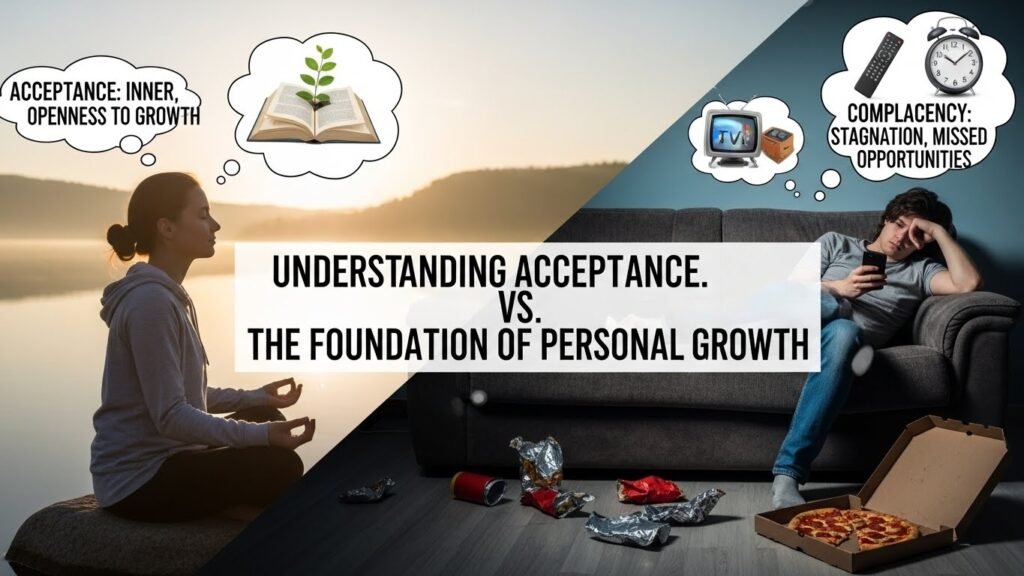
Acceptance and complacency represent two fundamentally different approaches to personal development that often appear deceptively similar on the surface.
Acceptance vs. complacency in personal growth centers on the paradox that true change begins with acknowledging reality as it exists, while complacency represents a passive resignation that prevents meaningful transformation.
Understanding this distinction becomes crucial for anyone seeking authentic personal development, as research in acceptance psychology demonstrates that genuine acceptance actually facilitates growth rather than hindering it.
The key lies in recognizing that acceptance is an active process of engagement with reality that creates space for intentional change, whereas complacency is a state of comfortable stagnation that resists any form of disruption or improvement.
- Acceptance acknowledges current reality while maintaining openness to change and growth
- Complacency creates false comfort by avoiding challenges and maintaining the status quo
- Personal growth requires understanding when to accept circumstances and when to pursue change
- The acceptance vs. complacency distinction determines whether you progress or remain stagnant
- Psychological flexibility serves as the bridge between acceptance and meaningful action

Truth #1: Acceptance Embraces Reality While Complacency Denies Growth Potential
The first powerful truth about acceptance vs. complacency reveals how acceptance fundamentally embraces reality in its entirety, including both pleasant and unpleasant aspects, while complacency selectively acknowledges only what feels comfortable or convenient.
Acceptance psychology research demonstrates that when individuals practice genuine acceptance, they develop heightened awareness of their current situation, emotional state, and behavioral patterns without judgment or resistance.
This comprehensive awareness creates the foundation for informed decision-making and intentional change, as Carl Rogers famously stated, “The curious paradox is that when I accept myself just as I am, then I can change.”
Conversely, complacency operates through selective attention and cognitive distortion, focusing only on positive aspects while ignoring areas requiring attention or improvement, ultimately creating a false sense of security that prevents recognition of growth opportunities.
- Acceptance involves complete acknowledgment of current reality without resistance or denial
- Complacency selectively focuses on comfortable aspects while ignoring necessary changes
- Research shows acceptance increases self-awareness and emotional intelligence
- Growth potential remains hidden when complacency dominates mindset
- True acceptance creates clarity that enables strategic personal development

Truth #2: Psychological Flexibility Distinguishes Acceptance from Complacency
Psychological flexibility serves as the definitive factor that separates healthy acceptance from detrimental complacency, representing the ability to adapt thoughts and behaviors in service of valued goals while maintaining contact with the present moment.
Studies in acceptance and commitment therapy show that individuals with high psychological flexibility can acknowledge difficult emotions and challenging circumstances without becoming stuck in them, using acceptance as a launching point for value-driven action.
This flexibility contrasts sharply with the rigid, fixed mindset characteristic of complacency, where individuals become so attached to their current comfort zone that they resist any suggestion of change or improvement.
The acceptance vs. complacency dynamic becomes particularly evident when facing challenges, as psychologically flexible individuals use acceptance to navigate obstacles while maintaining growth momentum, whereas complacent individuals use acceptance as an excuse to avoid necessary discomfort or effort.
- Psychological flexibility enables adaptation while maintaining core values and goals
- Complacency creates rigid thinking patterns that resist change and innovation
- Research links psychological flexibility to improved mental health and achievement
- Acceptance combined with flexibility creates resilience during challenging transitions
- Growth mindset requires flexibility to navigate between acceptance and ambition

Truth #3: Mindfulness Practices Reveal the Acceptance vs. Complacency Paradox
Mindfulness meditation and acceptance-based practices illuminate the paradoxical relationship between acceptance and personal growth, demonstrating how present-moment awareness actually enhances rather than diminishes motivation for improvement.
Recent research published in Frontiers in Psychology reveals that mindfulness training significantly increases acceptance levels while simultaneously improving performance outcomes and cognitive flexibility, suggesting that acceptance and achievement are complementary rather than contradictory forces.
The practice of mindfulness reveals how complacency often masquerades as acceptance by creating a false sense of present-moment satisfaction that actually disconnects individuals from their authentic experience and values.
True mindfulness-based acceptance involves deep engagement with reality that naturally reveals areas aligned with personal values that warrant attention and action, while complacency represents a superficial, disengaged relationship with the present that prevents authentic self-assessment and growth.
- Mindfulness increases both acceptance and motivation for value-aligned action
- Present-moment awareness reveals authentic needs versus superficial comfort
- Research demonstrates mindfulness improves acceptance and performance simultaneously
- Complacency creates false mindfulness that avoids genuine self-awareness
- Acceptance through mindfulness enables recognition of growth opportunities

Truth #4: Values-Based Living Transforms Acceptance into Action
The transformation of acceptance from passive resignation into dynamic personal growth occurs through the clarifying lens of personal values, which provide direction and motivation for meaningful action while maintaining authentic acceptance of present circumstances.
Acceptance and commitment therapy research demonstrates that when individuals connect their acceptance practices to clearly defined personal values, acceptance becomes a powerful catalyst for committed action rather than a justification for complacency.
This values-based approach reveals how acceptance vs. complacency operates differently in relation to personal meaning, as genuine acceptance acknowledges current reality while maintaining commitment to values-driven goals, whereas complacency uses acceptance as a rationalization for avoiding value-aligned challenges.
The distinction becomes particularly powerful when individuals recognize that acceptance of current limitations actually enables more effective action toward valued directions by eliminating energy wasted on resistance and self-criticism.
- Values clarification transforms acceptance from passive to active engagement
- Research shows values-based acceptance increases goal achievement and life satisfaction
- Complacency avoids values-based challenges that require effort and growth
- Acceptance enables efficient energy use by eliminating resistance to reality
- Personal meaning provides direction for acceptance-based growth strategies

Truth #5: Long-term Growth Requires Navigating Between Acceptance and Ambition
Sustainable personal development demands sophisticated navigation between the complementary forces of acceptance and ambition, requiring individuals to develop wisdom about when to practice acceptance and when to pursue aggressive change.
Longitudinal studies in personal growth psychology reveal that individuals who master the acceptance vs. complacency balance demonstrate greater resilience, achievement, and life satisfaction compared to those who exclusively emphasize either acceptance or ambition.
This navigation involves recognizing that different life domains and circumstances require varying approaches, with some situations calling for deep acceptance of unchangeable realities while others demand ambitious action and transformation.
The key insight reveals that acceptance and ambition operate as interdependent forces rather than opposing concepts, as proper acceptance creates the psychological foundation necessary for sustainable ambitious action by reducing internal resistance and increasing clarity about authentic desires and capabilities.
- Long-term success requires balancing acceptance with strategic ambition
- Research indicates balanced approach yields superior outcomes versus extreme positions
- Wisdom involves knowing when to accept versus when to pursue change
- Acceptance and ambition function as complementary rather than opposing forces
- Sustainable growth emerges from acceptance-ambition integration
The Science Behind Acceptance vs. Complacency
| Aspect | Acceptance | Complacency |
|---|---|---|
| Psychological Foundation | Mindfulness-based engagement with reality | Avoidance-based disengagement from challenges |
| Neurological Impact | Activates prefrontal cortex regions associated with self-regulation | Triggers default mode network associated with automatic patterns |
| Emotional Regulation | Increases emotional intelligence and resilience | Decreases emotional awareness and adaptability |
| Behavioral Outcomes | Promotes value-aligned action and growth | Maintains status quo and prevents change |
| Cognitive Patterns | Enhances cognitive flexibility and openness | Creates rigid thinking and resistance to new information |
| Motivation System | Activates intrinsic motivation based on values | Relies on external validation and comfort-seeking |
| Stress Response | Reduces chronic stress through realistic appraisal | Increases stress through avoidance and denial |
| Performance Impact | Improves performance through focused attention | Decreases performance through disengagement |
| Long-term Effects | Builds psychological flexibility and resilience | Creates stagnation and decreased life satisfaction |
Practical Strategies for Cultivating Healthy Acceptance
Developing healthy acceptance requires intentional practice and strategic approaches that distinguish genuine acceptance from complacency while building psychological flexibility.
Research-backed techniques from acceptance and commitment therapy provide practical frameworks for cultivating acceptance that enhances rather than hinders personal growth, focusing on present-moment awareness, values clarification, and committed action.
These strategies must be implemented with careful attention to the acceptance vs. complacency distinction, ensuring that acceptance practices serve as foundations for growth rather than rationalizations for stagnation.
The most effective approaches combine mindfulness techniques with values-based goal setting, creating integrated practices that honor current reality while maintaining momentum toward desired futures.
- Practice daily mindfulness meditation focusing on present-moment awareness without judgment
- Develop values clarification exercises to identify authentic personal directions
- Use cognitive defusion techniques to observe thoughts without becoming fused with them
- Implement regular self-reflection practices that distinguish acceptance from resignation
- Create committed action plans that align acceptance with growth-oriented goals
Warning Signs: When Acceptance Becomes Complacency
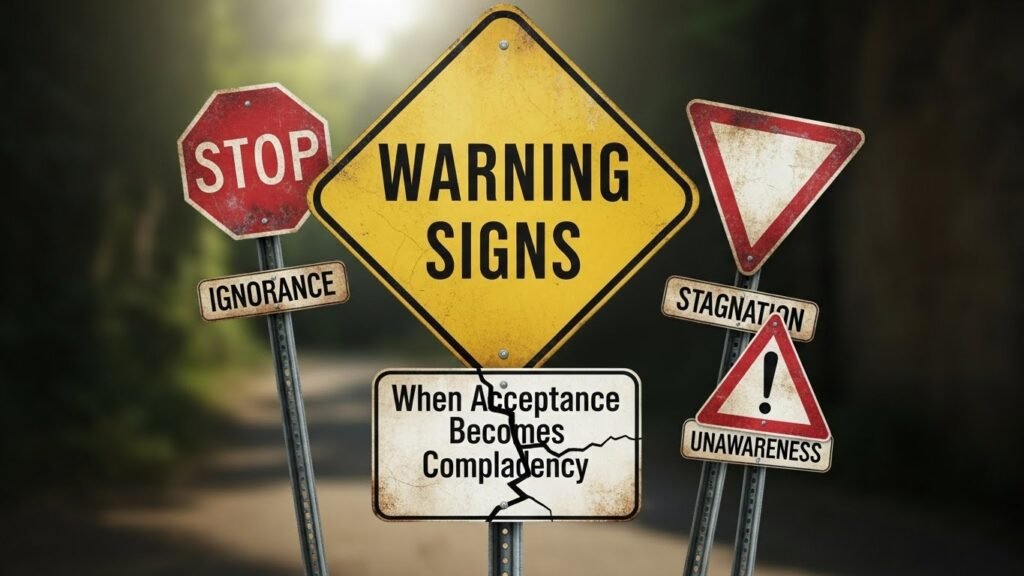
Recognizing the transition from healthy acceptance to detrimental complacency requires awareness of subtle psychological and behavioral indicators that reveal underlying resistance to growth and change.
The acceptance vs. complacency distinction often becomes blurred when individuals begin using acceptance language to justify avoidance behaviors or when present-moment focus becomes an excuse for ignoring long-term consequences and opportunities.
Warning signs typically manifest as decreased motivation for value-aligned activities, increased rationalization of stagnant behaviors, and diminished curiosity about learning and growth opportunities, indicating that acceptance has shifted from active engagement to passive resignation that prevents meaningful development.
- Decreased motivation for activities aligned with personal values and long-term goals
- Increased use of acceptance language to rationalize avoidance of challenges or discomfort
- Diminished curiosity and openness to new learning experiences and growth opportunities
- Excessive comfort with current circumstances despite misalignment with authentic desires
- Resistance to feedback or suggestions that might disrupt current comfort levels
The Role of Acceptance and Commitment Therapy (ACT)
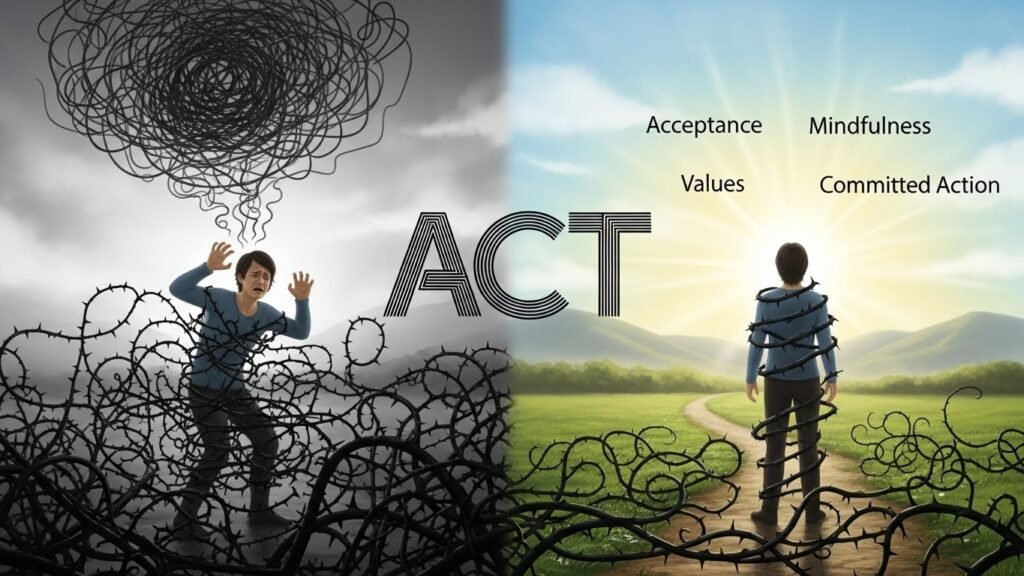
Acceptance and commitment therapy represents the most researched and systematically developed approach to navigating the acceptance vs. complacency distinction, providing structured protocols for developing psychological flexibility while maintaining commitment to personal growth.
ACT’s six core processes—acceptance, cognitive defusion, being present, self-as-context, values, and committed action—work synergistically to create psychological flexibility that enables individuals to practice genuine acceptance while avoiding the trap of complacency.
Clinical research demonstrates ACT’s effectiveness in treating various psychological conditions while simultaneously enhancing personal growth outcomes, suggesting that the therapy’s approach to acceptance creates optimal conditions for sustainable development and achievement.
- ACT provides systematic framework for developing psychological flexibility
- Research demonstrates effectiveness across multiple psychological and performance domains
- Six core processes integrate acceptance with committed value-driven action
- Clinical applications show improved outcomes for both mental health and achievement
- ACT techniques translate effectively to non-clinical personal development contexts
Building Psychological Resilience Through Acceptance
Psychological resilience emerges from the sophisticated integration of acceptance practices with growth-oriented behaviors, creating robust mental and emotional capacity to navigate challenges while maintaining development momentum.
Studies reveal that individuals who master the acceptance vs. complacency balance demonstrate superior resilience across multiple life domains, showing greater ability to recover from setbacks while maintaining focus on long-term objectives.
This resilience-building process involves developing acceptance skills that acknowledge current difficulties without becoming overwhelmed by them, while simultaneously maintaining commitment to values-based actions that promote growth and adaptation in response to changing circumstances.
- Acceptance builds emotional regulation capacity that supports resilience development
- Research links acceptance practices to improved stress management and recovery
- Psychological flexibility enables adaptive responses to changing circumstances
- Resilience requires balancing acceptance of current reality with commitment to growth
- Integration of acceptance and action creates sustainable resilience patterns
Conclusion: Embracing Acceptance While Avoiding Complacency
The distinction between acceptance vs. complacency represents a fundamental choice that determines whether personal growth becomes a dynamic reality or remains an elusive ideal, requiring conscious commitment to practices that honor present-moment reality while maintaining momentum toward valued futures.
The five powerful truths explored throughout this examination reveal that acceptance and growth operate as complementary forces rather than opposing concepts, with genuine acceptance serving as the foundation for sustainable personal development rather than an obstacle to overcome.
By integrating mindfulness practices, values-based living, and psychological flexibility development, individuals can cultivate acceptance that enhances rather than diminishes their capacity for meaningful achievement and authentic fulfillment.
The journey toward mastering acceptance while avoiding complacency demands ongoing practice and refinement, as the balance between these forces requires constant attention and adjustment in response to changing life circumstances and evolving personal values.
Those who successfully navigate this integration discover that acceptance becomes a source of strength and clarity that amplifies their ability to pursue ambitious goals with wisdom and resilience, creating sustainable patterns of growth that honor both current reality and future aspirations.
The ultimate insight reveals that acceptance vs. complacency is not a choice between opposing alternatives but rather an invitation to develop sophisticated psychological skills that enable authentic engagement with life in all its complexity while maintaining commitment to continuous growth and development.
Frequently Asked Questions About Acceptance vs. Complacency
What is the main difference between acceptance and complacency?
Acceptance involves active engagement with current reality while maintaining openness to growth and change, whereas complacency represents passive resignation to current circumstances that prevents development and improvement.
Can acceptance actually help with personal growth?
Research demonstrates that genuine acceptance enhances personal growth by reducing internal resistance, increasing self-awareness, and creating psychological space for value-aligned action and development.
How do I know if I’m practicing acceptance or just being complacent?
The key indicator lies in whether your mindset maintains openness to growth and value-aligned action (acceptance) or uses current circumstances as justification for avoiding challenges and maintaining the status quo (complacency).
Does practicing acceptance mean giving up on goals and ambitions?
No, healthy acceptance actually supports goal achievement by eliminating energy wasted on resisting reality while maintaining commitment to values-based objectives and meaningful growth.
What role does mindfulness play in distinguishing acceptance from complacency?
Mindfulness creates present-moment awareness that reveals authentic needs and opportunities, preventing the false satisfaction that characterizes complacency while supporting genuine acceptance of current reality.
How can I practice acceptance without falling into complacency?
Develop values-based acceptance practices that acknowledge current reality while maintaining commitment to growth-oriented goals, using mindfulness and psychological flexibility techniques to navigate between acceptance and ambition.
Is complacency always harmful to personal development?
While comfort and contentment have their place, complacency becomes harmful when it prevents recognition of growth opportunities, creates resistance to necessary change, or maintains misalignment with authentic values and aspirations.
Can therapy help with acceptance vs. complacency issues?
Acceptance and commitment therapy (ACT) specifically addresses this distinction, providing structured approaches for developing healthy acceptance while maintaining growth momentum and avoiding complacency traps.
How does psychological flexibility relate to acceptance and complacency?
Psychological flexibility represents the capacity to adapt thoughts and behaviors in service of values while accepting present reality, serving as the key skill that distinguishes healthy acceptance from detrimental complacency.
What are practical signs that acceptance has become complacency?
Warning signs include decreased motivation for value-aligned activities, increased rationalization of stagnant behaviors, diminished curiosity about growth opportunities, and resistance to feedback that might disrupt current comfort levels.
References:
- O’Sullivan Counseling. (2024). “Acceptance is Not Complacency”
- Frontiers in Psychology. (2024). “Mindfulness and acceptance-based training for elite athletes”
- Psychology Today. (2022). “Acceptance and Commitment Therapy”
- Empowered Times. (2021). “The Paradox of Acceptance”
- Harvard Gazette. (2018). “When science meets mindfulness”
- Clinical Practice and Epidemiology in Mental Health. (2023). “Randomized Controlled Trial of Mindfulness-Acceptance-Commitment Approach”