📋 Table of Contents
- Understanding Boundaries vs. Walls: The Fundamental Difference
- The Psychology Behind Boundaries vs. Walls
- Truth #1: Boundaries Create Connection While Walls Prevent Intimacy
- Truth #2: Boundaries Are Flexible While Walls Are Rigid
- Truth #3: Boundaries Protect Relationships While Walls Destroy Them
- Truth #4: Boundaries Allow Vulnerability While Walls Prevent Authenticity
- Truth #5: Boundaries Evolve While Walls Remain Static
- Truth #6: Boundaries Build Trust While Walls Create Suspicion
- Truth #7: Boundaries Communicate Clearly While Walls Create Confusion
- Truth #8: Boundaries Foster Growth While Walls Stagnate Relationships
- Truth #9: Boundaries Respect Both Parties While Walls Disrespect Everyone
- Truth #10: Boundaries Create Safety While Walls Create Fear
- Practical Applications: When to Use Boundaries vs. When to Build Walls
- The Complete Boundaries vs. Walls Framework
- Real Relationship Transformation Stories
- Frequently Asked Questions
- Your Journey from Walls to Boundaries Begins Now

🧠 Understanding Boundaries vs. Walls: The Fundamental Difference
The distinction between boundaries vs. walls represents one of the most crucial yet misunderstood concepts in relationship psychology.
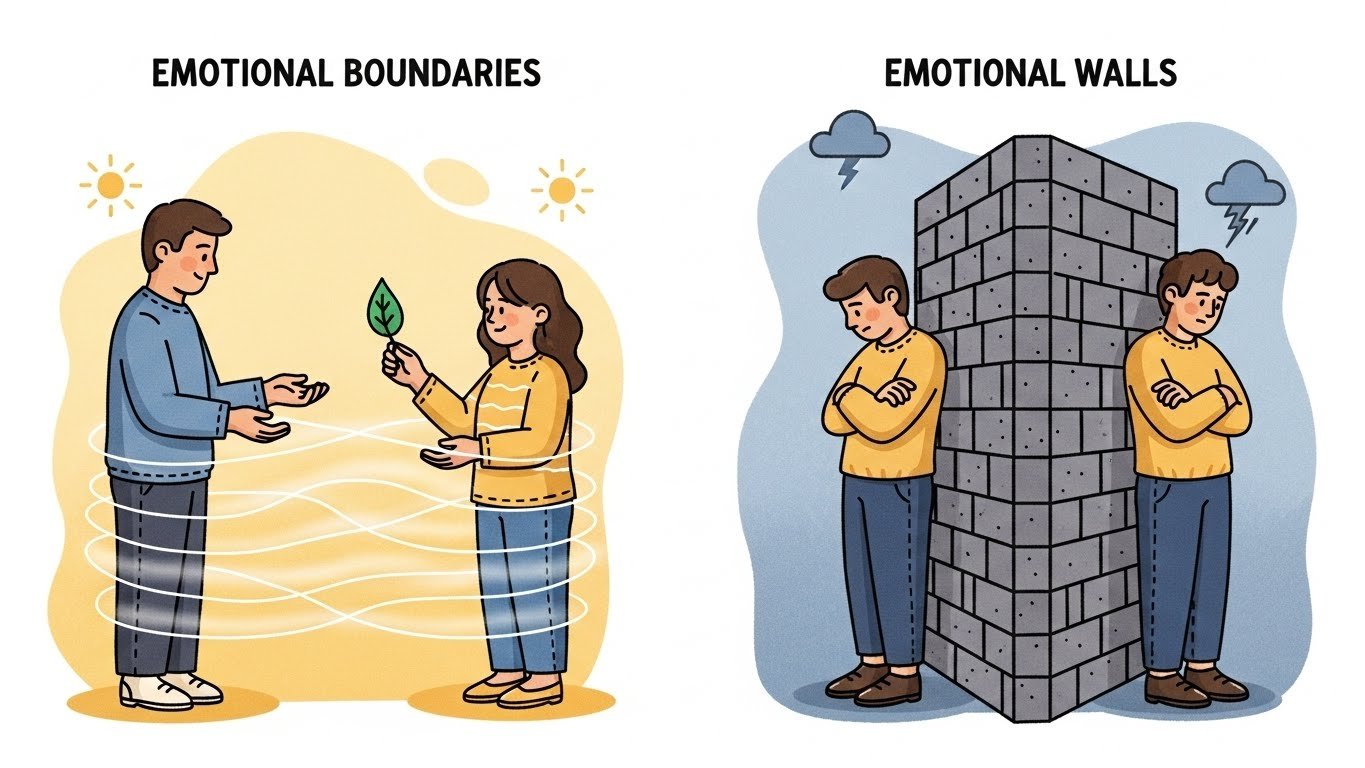
Boundaries are flexible, permeable guidelines that define what is acceptable and unacceptable in relationships while maintaining connection and mutual respect.
Walls, conversely, are rigid, impenetrable barriers that completely block interaction, intimacy, and authentic connection, often stemming from fear, past trauma, or defensive programming.
Boundaries operate from a place of self-respect and relationship preservation – they’re like healthy cell membranes that allow necessary exchange while maintaining individual integrity.
Research from attachment psychology shows that individuals with healthy boundary skills have significantly more satisfying relationships, better emotional regulation, and lower anxiety levels.
Boundaries communicate clearly: “This is me, this is you, and here’s how we can connect safely and respectfully.”
Key Points:
- Boundaries are flexible guidelines maintaining connection while defining acceptability
- Walls are rigid barriers blocking interaction, intimacy, and authentic connection
- Boundaries operate from self-respect and relationship preservation
- Walls operate from fear and self-protection, preventing necessary connection

🔬 The Psychology Behind Boundaries vs. Walls
The psychology behind boundaries vs. walls reveals fascinating insights into human relationship patterns and their impact on mental health.
Research from developmental psychology shows that healthy boundary development begins in childhood through secure attachment relationships, where children learn that their needs are valid while also learning to consider others’ needs.
This creates what psychologists call “differentiated self” – the ability to maintain individual identity while remaining emotionally connected to others.
Walls, however, often develop as protective mechanisms in response to trauma, neglect, or inconsistent caregiving.
When children learn that relationships are unsafe or that their needs won’t be met, they develop defensive patterns that become emotional walls in adulthood.
Research from trauma psychology shows that individuals who build emotional walls often have elevated cortisol levels, increased anxiety, and difficulty with emotional regulation, even when they’re not consciously aware of their defensive patterns.
The neurobiology is equally revealing: healthy boundaries activate the prefrontal cortex (responsible for executive function and emotional regulation), while walls trigger the amygdala (fear center) and create chronic stress responses.
This means that practicing healthy boundaries literally rewires your brain for better emotional regulation, while operating from walls keeps you in a constant state of defensive arousal that impacts both mental and physical health.
Key Points:
- Healthy boundaries develop through secure attachment and create differentiated self
- Walls develop as protective mechanisms in response to trauma or neglect
- Boundaries activate prefrontal cortex for better emotional regulation
- Walls trigger amygdala and create chronic stress responses

Truth #1: Boundaries Create Connection While Walls Prevent Intimacy
The first fundamental truth reveals that boundaries create connection while walls prevent intimacy – a distinction that transforms how we approach relationship safety.
Healthy boundaries create what researchers call “secure connection spaces” where both parties feel safe to be vulnerable, authentic, and emotionally available.
These boundaries function like healthy cell membranes, allowing necessary emotional exchange while maintaining individual integrity and safety.
Walls, however, create what psychologists term “emotional fortresses” that block the very intimacy relationships require for growth and deepening.
When you build walls, you might feel temporarily safe from potential hurt or rejection, but you also prevent the authentic connection that makes relationships meaningful and fulfilling.
Research shows that individuals with healthy boundaries report significantly higher relationship satisfaction and deeper intimacy levels compared to those who operate from walls.
The practical implication is profound: when you set healthy boundaries, you’re actually creating the conditions for deeper connection, while walls keep you isolated even when you’re physically present with others.
This explains why people with healthy boundaries often experience more satisfying relationships despite being more selective about their connections.
Key Points:
- Boundaries create secure connection spaces for vulnerability and authenticity
- Walls create emotional fortresses that block intimacy and connection
- Boundaries allow necessary emotional exchange while maintaining safety
- Healthy boundaries correlate with higher relationship satisfaction and deeper intimacy

Truth #2: Boundaries Are Flexible While Walls Are Rigid
The second transformative truth reveals that boundaries are flexible and adaptable while walls are rigid and inflexible, creating dramatically different relationship dynamics.
Healthy boundaries function like living cell membranes – they adjust based on context, relationship depth, and changing circumstances while maintaining their essential protective function.
This flexibility allows relationships to evolve and deepen naturally while maintaining appropriate safety levels.
Walls, however, function like concrete barriers – they remain static regardless of context, relationship changes, or growth opportunities.
Research from relationship psychology shows that individuals with rigid boundaries (walls) often struggle with relationship evolution, finding it difficult to deepen connections even when it’s safe and appropriate to do so.
This rigidity can leave relationships stuck at superficial levels despite genuine opportunities for deeper connection.
The flexibility of boundaries allows for what researchers call “gradual intimacy building” – the natural deepening of relationships through increasing vulnerability and trust.
As relationships prove themselves safe and authentic, boundaries can relax appropriately, allowing for deeper connection while maintaining core safety.
Walls prevent this natural evolution, keeping relationships stuck at the same level regardless of changing circumstances or growing trust.
Key Points:
- Boundaries are flexible and adaptable like living cell membranes
- Walls are rigid and inflexible like concrete barriers
- Flexibility allows relationships to evolve and deepen naturally
- Rigidity keeps relationships stuck regardless of changing circumstances

Truth #3: Boundaries Protect Relationships While Walls Destroy Them
The third fundamental truth reveals that boundaries protect relationships while walls destroy them – a distinction that transforms how we approach relationship safety.
Healthy boundaries function like relationship immune systems, protecting the connection from harmful behaviors, energetic drains, and boundary violations while allowing the relationship itself to thrive and grow stronger through appropriate challenges and growth opportunities.
Walls, however, function like relationship autoimmune diseases – they attack the very connection they’re meant to protect, often destroying relationships through excessive defensiveness, emotional unavailability, and connection-blocking behaviors.
Research from couples therapy shows that relationships with healthy boundaries have significantly higher survival rates and satisfaction levels compared to those operating from walls, even when facing similar challenges.
The protective function of boundaries operates through what researchers call “selective permeability” – allowing beneficial elements (love, support, growth) while blocking harmful elements (abuse, manipulation, disrespect).
This selective function strengthens relationships by creating safety for vulnerability while preventing damage from harmful behaviors.
Walls, however, block everything indiscriminately, preventing both harm and healing, ultimately leading to relationship starvation and death.
Key Points:
- Boundaries function like relationship immune systems protecting from harmful behaviors
- Walls function like autoimmune diseases attacking the connection they’re meant to protect
- Boundaries have selective permeability allowing beneficial elements while blocking harm
- Walls block everything indiscriminately leading to relationship starvation

Truth #4: Boundaries Allow Vulnerability While Walls Prevent Authenticity
The fourth transformative truth reveals that boundaries allow vulnerability while walls prevent authenticity – a distinction that determines the depth and authenticity of relationships.
Healthy boundaries create what researchers call “safe vulnerability spaces” where both parties can be authentic, express true feelings, and show their real selves while maintaining appropriate safety and respect.
Walls, however, create what psychologists term “authenticity barriers” that prevent genuine self-expression, emotional intimacy, and real connection.
When you operate from walls, you might feel safe from potential hurt or rejection, but you also prevent the very authenticity that makes relationships meaningful and transformative.
Research shows that relationships with healthy boundaries report significantly higher levels of authentic connection and emotional intimacy.
The vulnerability-allowing function of boundaries operates through what researchers call “graduated authenticity” – the natural process of revealing more of your true self as relationships prove themselves safe and trustworthy.
This creates deepening connection through increasing authenticity while maintaining appropriate safety.
Walls prevent this natural deepening, keeping relationships superficial and preventing the transformative intimacy that comes from being truly seen and known.
Key Points:
- Boundaries create safe vulnerability spaces for authentic self-expression
- Walls create authenticity barriers preventing genuine connection
- Boundaries allow graduated authenticity as relationships prove safe
- Walls prevent transformative intimacy that comes from being truly seen

Truth #5: Boundaries Evolve While Walls Remain Static
The fifth fundamental truth reveals that boundaries evolve and adapt while walls remain static and unchanging, creating dramatically different relationship trajectories.
Healthy boundaries function like living organisms – they grow, adapt, and evolve based on relationship development, changing circumstances, and personal growth, allowing relationships to deepen and transform naturally over time.
Walls, however, function like static structures – they remain unchanged regardless of relationship development, personal growth, or changing circumstances, often keeping relationships stuck at the same level despite genuine opportunities for deepening and transformation.
Research from developmental psychology shows that individuals with evolving boundaries experience significantly more relationship satisfaction and personal growth compared to those operating from static walls.
The evolutionary nature of boundaries allows for what researchers call “relationship maturation” – the natural deepening and transformation of relationships through increasing trust, vulnerability, and authentic connection.
As relationships prove themselves safe and authentic, boundaries can evolve to allow deeper connection while maintaining core safety.
Walls prevent this natural maturation, keeping relationships stuck at the same developmental level regardless of growing trust or changing circumstances.
Key Points:
- Boundaries evolve and adapt like living organisms based on relationship development
- Walls remain static and unchanging regardless of circumstances or growth
- Evolutionary boundaries allow relationship maturation and natural deepening
- Static walls prevent natural relationship development and transformation

Truth #6: Boundaries Build Trust While Walls Create Suspicion
The sixth transformative truth reveals that boundaries build trust while walls create suspicion – a distinction that determines the foundation of relationship security.
Healthy boundaries function like trust-building mechanisms – they create predictable, respectful interactions that allow both parties to feel safe being vulnerable and authentic, building what researchers call “earned security” through consistent, respectful behavior.
Walls, however, function like suspicion-creators – they create unpredictable, defensive interactions that make both parties feel unsafe and unsure about the relationship’s stability and authenticity.
Research from attachment psychology shows that relationships with healthy boundaries develop significantly higher levels of trust and security compared to those operating from walls, even when both parties genuinely want connection.
The trust-building function of boundaries operates through what researchers call “predictable respect” – consistent demonstration of respect for self and others that creates safety for vulnerability and authentic connection.
This predictability creates earned trust that deepens over time.
Walls, however, create unpredictability through defensive behaviors and emotional unavailability, making it impossible to build the earned trust that secure relationships require.
Key Points:
- Boundaries function as trust-building mechanisms creating predictable, respectful interactions
- Walls function as suspicion-creators creating unpredictable, defensive interactions
- Boundaries build “earned security” through consistent, respectful behavior
- Walls create unpredictability making earned trust impossible to build

Truth #7: Boundaries Communicate Clearly While Walls Create Confusion
The seventh fundamental truth reveals that boundaries communicate clearly while walls create confusion – a distinction that determines relationship clarity and understanding.
Healthy boundaries function like clear communication systems – they express needs, expectations, and limits in ways that others can understand and respond to appropriately, creating what researchers call “relational clarity” that allows for mutual understanding and respect.
Walls, however, function like communication barriers – they express nothing clearly, leaving others confused about needs, expectations, and limits, often creating what researchers term “relational confusion” that leads to misunderstandings, hurt feelings, and damaged relationships.
Research from communication psychology shows that relationships with clear boundaries have significantly fewer misunderstandings and conflicts compared to those operating from walls.
The clear communication function of boundaries operates through what researchers call “direct expression” – honest, clear communication about needs, limits, and expectations that others can understand and respond to appropriately. This clarity creates mutual understanding and respect.
Walls, however, communicate nothing directly, leaving others to guess about needs and limits, often leading to incorrect assumptions and relationship damage.
Key Points:
- Boundaries function as clear communication systems expressing needs and expectations
- Walls function as communication barriers expressing nothing clearly
- Boundaries create relational clarity allowing mutual understanding and respect
- Walls create relational confusion leading to misunderstandings and damaged relationships

Truth #8: Boundaries Foster Growth While Walls Stagnate Relationships
The eighth transformative truth reveals that boundaries foster growth while walls stagnate relationships – a distinction that determines relationship evolution and personal development.
Healthy boundaries function like growth-fostering environments – they create conditions where both individuals and the relationship itself can evolve, deepen, and transform through appropriate challenges, safe risks, and authentic connection.
Walls, however, function like growth-stagnating environments – they prevent the very challenges, risks, and authentic connections that relationships need for evolution and transformation, often keeping both individuals and relationships stuck at the same developmental level despite genuine opportunities for growth and deepening.
Research from relationship psychology shows that relationships with growth-fostering boundaries evolve significantly more than those operating from stagnation-creating walls.
The growth-fostering function of boundaries operates through what researchers call “appropriate challenge” – safe risks and authentic connections that promote individual and relationship evolution while maintaining appropriate safety.
This creates dynamic relationships that evolve and deepen over time. Walls, however, prevent appropriate challenge, keeping relationships static and preventing the evolution that authentic connection requires for growth and transformation.
Key Points:
- Boundaries function as growth-fostering environments allowing evolution and transformation
- Walls function as growth-stagnating environments preventing necessary challenges
- Boundaries create appropriate challenges promoting individual and relationship evolution
- Walls prevent appropriate challenge keeping relationships static and preventing evolution
Truth #9: Boundaries Respect Both Parties While Walls Disrespect Everyone
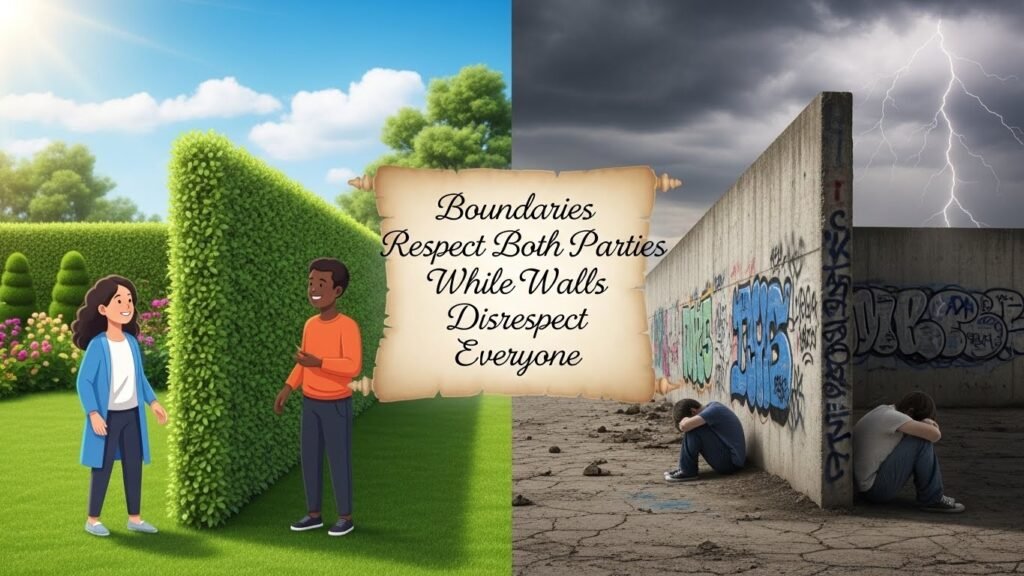
The ninth fundamental truth reveals that boundaries respect both parties while walls disrespect everyone involved – a distinction that determines the dignity and humanity of relationship interactions.
Healthy boundaries function like mutual respect systems – they honor your needs, values, and limits while also respecting the other person’s humanity, needs, and right to make informed choices about the relationship.
Walls, however, function like mutual disrespect systems – they dishonor your own needs by preventing authentic expression, while also disrespecting the other person by denying them the opportunity to respond to your authentic needs and make informed choices about the relationship.
Research from relationship ethics shows that relationships based on mutual respect through healthy boundaries have significantly higher satisfaction and longevity compared to those based on mutual disrespect through walls.
The mutual respect function of boundaries operates through what researchers call “dignified expression” – honest, clear communication about needs and limits that honors both your own humanity and the other person’s right to make informed choices.
This creates relationships based on mutual dignity and respect. Walls, however, create relationships based on mutual disrespect by denying authentic expression and informed choice to both parties.
Key Points:
- Boundaries function as mutual respect systems honoring both parties’ humanity and needs
- Walls function as mutual disrespect systems dishonoring both parties’ needs and humanity
- Boundaries create relationships based on mutual dignity and respect
- Walls create relationships based on mutual disrespect by denying authentic expression

Truth #10: Boundaries Create Safety While Walls Create Fear
The tenth and perhaps most fundamental truth reveals that boundaries create safety while walls create fear – a distinction that determines the emotional foundation of relationships.
Healthy boundaries function like safety-creating systems – they provide clear, predictable guidelines that create emotional safety for vulnerability, authenticity, and growth while maintaining appropriate protection from harm.
Walls, however, function like fear-creating systems – they operate from fear of hurt, rejection, or abandonment, creating chronic anxiety about relationships and preventing the very safety that authentic connection requires for growth and intimacy.
Research from trauma psychology shows that relationships based on safety through healthy boundaries create significantly more emotional security and well-being compared to those based on fear through walls.
The safety-creating function of boundaries operates through what researchers call “earned safety” – the creation of predictable, respectful interactions that allow for vulnerability and authentic connection while maintaining appropriate protection.
This creates genuine emotional safety that supports growth and intimacy. Walls, however, create chronic fear that prevents the very safety that authentic relationships require for growth and transformation.
Key Points:
- Boundaries function as safety-creating systems providing clear, predictable guidelines
- Walls function as fear-creating systems operating from fear of hurt and rejection
- Boundaries create earned safety through predictable, respectful interactions
- Walls create chronic fear preventing the safety authentic relationships require

🎯 Practical Applications: When to Use Boundaries vs. When to Build Walls
Understanding when to use boundaries vs. when to build walls requires developing what psychologists call “situational discernment” – the ability to recognize which approach serves your highest good in different circumstances.
This discernment is crucial for creating relationships that are both safe and fulfilling, allowing you to protect yourself appropriately while remaining open to authentic connection and growth.
The key distinction lies in recognizing whether a situation requires flexible guidelines that can evolve with changing circumstances, or whether it requires complete disconnection for safety and healing.
Boundaries are appropriate when you want to maintain connection while creating safety, when the relationship has potential for growth and healing, or when you want to teach others how to treat you respectfully.
Walls may be necessary when safety is severely compromised, when repeated boundary violations have occurred without change, or when healing requires complete disconnection.
Practical application involves developing what researchers call “discernment skills” – the ability to assess situations accurately and choose appropriate responses.
This might involve evaluating whether a relationship has potential for growth, assessing whether your safety is severely compromised, or recognizing whether you’re operating from fear or wisdom in your relationship choices.
Key Points:
- Situational discernment recognizes which approach serves highest good in different circumstances
- Boundaries appropriate when maintaining connection while creating safety
- Walls may be necessary when safety severely compromised or healing requires disconnection
- Discernment skills involve accurate assessment and appropriate response choice
📊 The Complete Boundaries vs. Walls Framework
| Aspect | Healthy Boundaries | Emotional Walls | Relationship Impact | Long-term Results | Communication Style |
|---|---|---|---|---|---|
| Purpose | Protection + connection | Isolation only | Growth vs. stagnation | Evolutionary vs. static | Clear vs. confusing |
| Flexibility | Adaptable & evolving | Rigid & static | Dynamic vs. stuck | Growth vs. limitation | Negotiable vs. fixed |
| Intimacy | Allows vulnerability | Blocks authenticity | Deep vs. superficial | Satisfying vs. empty | Open vs. closed |
| Communication | Clear & direct | Vague/absent | Understanding vs. confusion | Functional vs. dysfunctional | Honest vs. avoidant |
| Trust building | Creates safety | Creates suspicion | Secure vs. anxious | Stable vs. unstable | Consistent vs. unpredictable |
| Growth support | Fosters development | Prevents evolution | Thriving vs. surviving | Expanding vs. limiting | Encouraging vs. restrictive |
| Respect level | Mutual dignity | Mutual disrespect | Healthy vs. toxic | Respectful vs. harmful | Dignified vs. demeaning |
| Safety type | Earned security | Fear-based isolation | Secure vs. anxious | Stable vs. unstable | Predictable vs. chaotic |
💫 Real Relationship Transformation Stories
Sarah’s Marriage Revolution: After 15 years of building walls in her marriage due to past relationship trauma, Sarah discovered the difference between boundaries and walls through couples therapy. “I thought I was protecting myself by keeping my husband at arm’s length,” she shares. “Learning to set healthy boundaries while staying emotionally available transformed our relationship completely. Within a year, we had the deepest connection we’d ever had, and I finally felt safe being truly seen by him.”
Michael’s Family Transformation: Coming from a family where walls were the norm, Michael struggled with intimacy in all his relationships. “I learned to build walls so high that no one could reach me,” he explains. “Understanding that boundaries could actually create deeper connection was revolutionary. Learning to set flexible boundaries while staying emotionally present allowed me to have relationships I never thought possible. My family relationships transformed completely.”
❓ Frequently Asked Questions About Boundaries vs. Walls {#faqs}
Q1: How do I know if I’m setting healthy boundaries or building walls?
A: Check your emotional state and relationship impact: healthy boundaries feel empowering and create connection, while walls feel isolating and create distance. If you feel more connected and respected after setting limits, you’re using boundaries. If you feel isolated and misunderstood, you might be building walls.
Q2: Can walls ever be appropriate or necessary in relationships?
A: Walls may be temporarily necessary in cases of severe abuse or when safety is severely compromised. However, they should be seen as temporary protective measures while you heal and develop healthy boundaries, not as permanent solutions for relationship challenges.
Q3: How do I transition from building walls to setting healthy boundaries?
A: Start by identifying your authentic needs and values, then practice expressing them clearly and respectfully. Begin with low-stakes relationships and gradually work toward more challenging ones. Consider working with a therapist to develop boundary-setting skills and heal any trauma that might be driving wall-building behavior.
Q4: What if people react negatively when I start setting boundaries instead of building walls?
A: Some people may initially react negatively because they’re used to your wall-building patterns. Stay consistent with your boundaries while remaining respectful. True friends and healthy partners will appreciate your authenticity and clarity, even if it takes time to adjust to the new dynamic.
Q5: How do I maintain boundaries without building walls in challenging relationships?
A: Focus on clear communication, consistent behavior, and remaining open to connection while maintaining your limits. Use “I” statements to express your needs, be specific about your boundaries, and follow through consistently while staying emotionally available for authentic connection.
Q6: How do boundaries vs. walls affect different types of relationships (romantic, family, work)?
A: The principles apply across all relationship types, but the specific implementation varies. Romantic relationships require emotional intimacy boundaries, family relationships may need generational pattern boundaries, and work relationships need professional boundary maintenance. The key is adapting the principles to each context while maintaining authentic connection.
Q7: Can you have healthy boundaries without completely removing walls?
A: Yes, you can maintain some protective walls while developing healthy boundaries. The key is being conscious about which walls serve your highest good and which ones limit your growth. Work on converting limiting walls into flexible boundaries while maintaining any walls that genuinely protect your wellbeing.
Q8: How do I know if my boundaries are too flexible or too rigid?
A: Check if your boundaries allow for relationship evolution while maintaining core safety. If you find yourself constantly compromising your core values or feeling disrespected, they may be too flexible. If you can’t adapt to changing circumstances or relationship growth, they may be too rigid. Healthy boundaries flex appropriately while maintaining essential protection.
Q9: What’s the difference between being “too nice” and having healthy boundaries?
A: Being “too nice” often means compromising your authentic needs to avoid conflict, while healthy boundaries mean expressing your needs clearly and respectfully. Healthy boundaries may feel uncomfortable initially, especially if you’re used to people-pleasing, but they ultimately create more authentic and satisfying relationships.
Q10: How long does it take to transition from building walls to setting healthy boundaries?
A: The timeline varies based on individual history and commitment to change, but most people notice improvements within 3-6 months of consistent practice. Deep-seated patterns may take longer to transform. The key is consistent practice, patience with yourself, and celebrating small victories as you develop this crucial life skill.
🌟 Your Journey from Walls to Boundaries Begins Now {#conclusion}
You’ve just discovered 10 eye-opening truths about boundaries vs. walls in relationships – distinctions that can literally transform every relationship in your life.
These aren’t just theoretical concepts – they’re practical tools for creating the authentic, satisfying relationships you’ve always wanted while maintaining the safety and respect you deserve.
The profound truth about boundaries vs. walls: You don’t need to choose between protecting yourself and connecting with others – healthy boundaries allow you to do both. When you master the art of setting flexible, authentic boundaries, you create the conditions for the deep, meaningful relationships you’ve always wanted while maintaining the safety and self-respect that healthy relationships require.
Your transformation timeline begins today:
- This week: Notice one relationship where you’re operating from walls instead of boundaries
- This month: Practice setting one healthy boundary while maintaining authentic connection
- This year: Experience how healthy boundaries transform your relationships and personal wellbeing
The path forward requires courage, not perfection:
- Start honest: Begin by recognizing where you’re currently building walls instead of setting boundaries
- Stay consistent: Practice setting healthy boundaries even when it feels uncomfortable
- Be patient: Developing boundary-setting skills takes time and practice
- Trust the process: Your relationships will transform as you develop this crucial life skill
Remember: Every time you choose healthy boundaries over emotional walls, you’re not just changing that relationship – you’re rewiring your entire approach to connection, intimacy, and authentic living. The space you create through healthy boundaries becomes the foundation for the deep, meaningful relationships you’ve always wanted.
Take the first honest look. Make the first boundary-setting choice. Begin your transformation from wall-building to boundary-setting.
Your journey from emotional isolation to authentic connection begins with that first conscious choice to set a healthy boundary rather than build another wall. 🌟
Ready to transform your relationships through healthy boundaries? Choose one relationship where you’re currently operating from walls and practice setting one healthy boundary this week. Share this article with someone who confuses boundaries with walls. The courage to set healthy boundaries will transform not just that relationship but your entire approach to connection and intimacy.
Happy boundary-setting – with authenticity, courage, and grace! ✨