
Your greatest obstacles aren’t outside of you—they live quietly in your thoughts. Break those hidden mental chains and you’ll unlock a future you didn’t know was possible.
Are hidden doubts holding you back? 🧠 Breaking limiting beliefs is the key to unlocking your full potential and transforming your mindset. By understanding the science of mental reprogramming and learning how to overcome limiting beliefs & mental reprogramming with positive affirmations, you can rewrite the inner dialogue that shapes your life.
Table of Contents
- Introduction: Why Limiting Beliefs Secretly Control Your Life
- What Are Limiting Beliefs?
- Limiting Beliefs Examples in Everyday Life
- Top 10 Self-Limiting Beliefs and Their Impact
- The Science of Mental Reprogramming
- 6 Steps to Breaking Limiting Beliefs
- How to Overcome Limiting Beliefs Daily
- Power of Positive Affirmations to Replace Negative Self-Talk
- Tools & Practices for Long-Term Mindset Freedom
- Case Study: From Doubt to Confidence
- Action Plan & Key Takeaways
- FAQs

1. Introduction: Why Limiting Beliefs Secretly Control Your Life
Your beliefs shape your reality more than external circumstances ever could. Hidden mental narratives dictate what you attempt and what you avoid.
- Limiting beliefs form silent barriers to success.
- They influence career choices, relationships, and self-worth.
- These thoughts often stem from early life experiences.
- Without awareness, they feel like absolute truth.
- Recognizing them is the first step to change.
- They drain confidence and block opportunity.
- Mental reprogramming dismantles these internal walls.
- Rewiring your mindset unlocks true potential.
- A growth mindset replaces fear with action.
- You can rewrite your inner story starting today.

2. What Are Limiting Beliefs?
Limiting beliefs are deeply rooted assumptions or thoughts that you accept as absolute truth—even though they’re not.
They usually develop from childhood experiences, cultural conditioning, or repeated disappointments and quietly shape how you see yourself and the world.
For example, if you once failed a math test and heard, “You’re just not good with numbers,” you might unconsciously carry the belief, “I can’t handle anything related to finance,” well into adulthood.
These beliefs create invisible mental walls that restrict your choices, influence your confidence, and keep you stuck in familiar patterns.
Left unchallenged, they become self-fulfilling prophecies, causing you to avoid opportunities that could actually prove the belief wrong.
Recognizing and questioning these hidden narratives is the first—and most crucial—step toward rewriting your inner story and unlocking your full potential.
Limiting beliefs are false assumptions accepted as fact, usually stored in the subconscious mind.
- They often arise from past trauma or societal expectations.
- Examples include “I’m not good enough” or “Money is evil.”
- They act as mental filters, distorting opportunities.
- They can masquerade as “just being realistic.”
- Childhood messages often plant these seeds.
- Repetition strengthens these neural patterns.
- They create self-fulfilling prophecies of failure.
- Without intervention, they persist for decades.
- Awareness allows you to challenge them logically.
- Mental reprogramming replaces them with empowering truths.
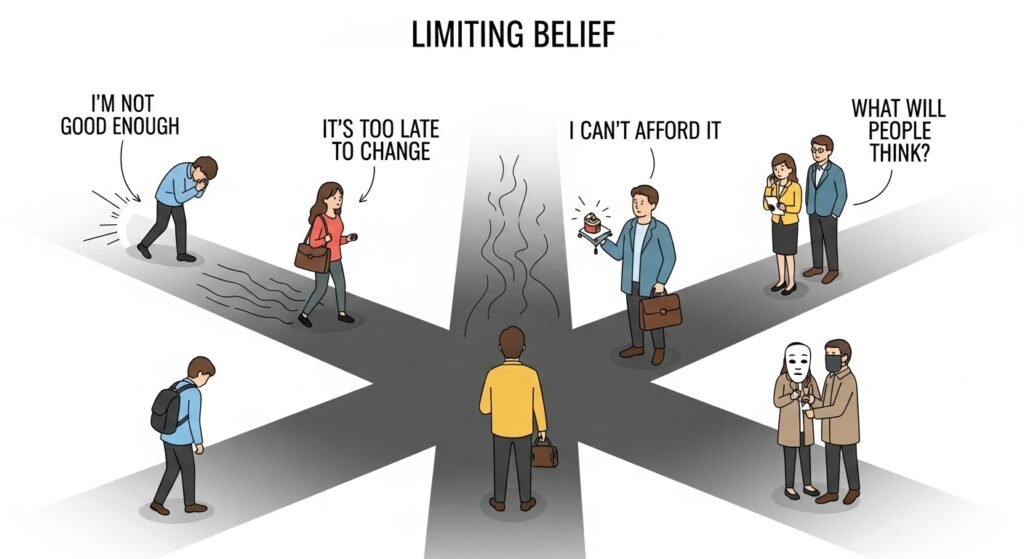
3. Limiting Beliefs Examples in Everyday Life
Limiting beliefs in everyday life are the habitual thoughts or assumptions that quietly restrict what you believe is possible for yourself.
They act as mental “rules” you accept without questioning, shaping your choices, confidence, and actions.
Examples:
- “I’m not talented enough to start my own business.”
- “I’ll never be financially secure—money is too hard to earn.”
- “I’m too old (or too young) to change careers.”
- “Relationships always end badly, so why try?”
- “I can’t speak in public; I’ll embarrass myself.”
- “I’m just not creative.”
- “I don’t deserve happiness.”
- “Success is only for lucky people.”
- “I’ll never find true love.”
- “Money is hard to keep.”
- “I must please everyone to be liked.”
These statements feel like facts but are actually learned beliefs—stories formed from past experiences, cultural messages, or other people’s opinions.
Recognizing these limiting beliefs is the first step to breaking them and replacing them with empowering, growth-oriented thoughts.

4. Top 10 Self-Limiting Beliefs and Their Impact
The top self-limiting beliefs—such as “I’m not good enough,” “I’ll never be successful,” or “I must be perfect to be accepted”—act like invisible chains that quietly shape your daily choices and long-term goals.
These beliefs can lower self-esteem, create fear of failure, and prevent you from pursuing opportunities that could change your life.
For example, believing that money is evil may cause you to avoid financial growth, while thinking you’re too old or too young can stop you from learning new skills or shifting careers.
Over time, these mental blocks become self-fulfilling prophecies, reinforcing feelings of inadequacy and keeping you in a cycle of stagnation.
By identifying these ten common limiting beliefs and understanding their emotional impact, you can begin to challenge them, replace them with empowering truths, and create a mindset that supports personal and professional growth.
Below are the top 10 self-limiting beliefs holding people back and their effects:
- I’m not good enough.
- I’ll fail if I try.
- I can’t change who I am.
- I don’t deserve success.
- I must be perfect to be accepted.
- Money is the root of problems.
- Relationships always end badly.
- I’m too old/too young to start.
- I can’t trust my own judgment.
- My dreams are unrealistic.
Each belief restricts growth and fuels negative self-talk.

5. The Science of Mental Reprogramming
Mental reprogramming is the process of deliberately changing the subconscious patterns that shape your thoughts, emotions, and behaviors.
Neuroscience shows that our brains are highly adaptable thanks to neuroplasticity—the ability to form new neural connections and break old ones.
When you consistently replace negative self-talk with positive affirmations, practice visualization, or use techniques like meditation and cognitive restructuring, you literally rewire the brain.
This shifts automatic responses, reduces stress triggers, and creates healthier belief systems.
By understanding how mental reprogramming works on a biological level—strengthening new pathways while weakening outdated ones—you gain the power to move beyond limiting beliefs and develop a mindset that supports confidence, resilience, and long-term personal growth.
Neuroscience proves the brain can form new connections—a process called neuroplasticity.
- Negative thoughts create reinforced neural pathways.
- Positive thoughts form new, empowering circuits.
- Repetition and emotional intensity speed change.
- Visualization activates the same brain areas as action.
- Meditation quiets the inner critic.
- Journaling strengthens awareness.
- Affirmations provide consistent positive input.
- CBT tools challenge irrational thinking.
- Small wins compound into larger breakthroughs.
- Mindset reprogramming is scientifically proven.

6. 6 Steps to Breaking Limiting Beliefs
| Step | Action | Purpose |
|---|---|---|
| 1 | Awareness | Identify the limiting belief. |
| 2 | Challenge | Question its validity. |
| 3 | Evidence | Find proof it’s false. |
| 4 | Reframe | Replace with a positive belief. |
| 5 | Act | Take aligned action to confirm new belief. |
| 6 | Reinforce | Repeat until it becomes second nature. |
- Awareness reveals hidden narratives.
- Challenge weakens their hold.
- Evidence shows reality beyond the belief.
- Reframing creates a new internal script.
- Aligned actions cement the change.
- Consistency builds permanent pathways.
- Patience is key; change takes repetition.
- Support systems accelerate growth.
- Track progress to stay motivated.
- Celebrate every mindset victory.

7. How to Overcome Limiting Beliefs Daily
Overcoming Breaking Limiting Beliefs & Mental Reprogramming is a daily practice that requires consistency and mindful action.
Begin by identifying your recurring negative thoughts—write them down to bring hidden patterns to light.
Challenge each belief by asking whether it’s based on fact or fear, then replace it with an empowering statement or positive affirmation.
Incorporate brief visualization exercises each morning, imagining yourself succeeding beyond those old mental barriers.
Use mindfulness or short meditation sessions to stay present and prevent automatic negative self-talk.
Surround yourself with supportive people who model growth-oriented thinking, and track small wins to reinforce your progress.
Over time, these daily habits reprogram your subconscious, proving to your mind that you are capable of far more than the outdated beliefs you once accepted.
Practical strategies to dismantle limiting thoughts:
- Start a daily belief journal.
- Use mindfulness to catch negative patterns.
- Replace each negative thought with an empowering one.
- Surround yourself with growth-minded peers.
- Visualize success vividly every morning.
- Practice gratitude to shift focus.
- Use small, bold actions to confirm new beliefs.
- Seek therapy or coaching if needed.
- Read personal development literature.
- Keep affirmations visible throughout your day.

8. Power of Positive Affirmations to Replace Negative Self-Talk
Positive affirmations are short, intentional statements that help retrain your subconscious mind to focus on confidence, resilience, and possibility.
When repeated consistently—especially out loud or in writing—they begin to override the automatic negative self-talk that fuels limiting beliefs.
For example, replacing “I’m not good enough” with “I am worthy of success and capable of growth” sends a powerful signal to the brain, activating new neural pathways that support self-belief.
Pairing affirmations with visualization and deep breathing enhances their impact, helping you embody the feelings of success and self-acceptance.
Over time, these affirmations shift your inner dialogue, raise self-esteem, and cultivate a mindset where opportunities and solutions naturally come into view.
Positive affirmations help install new beliefs. Examples:
- “I am worthy of success and abundance.”
- “Opportunities flow to me with ease.”
- “I create my own reality with confidence.”
- “I release fear and embrace growth.”
- “My potential is limitless.”
- “I trust myself fully.”
- “I deserve love and happiness.”
- “Money is a tool for good in my life.”
- “I am capable of great achievements.”
- “I am enough just as I am.”
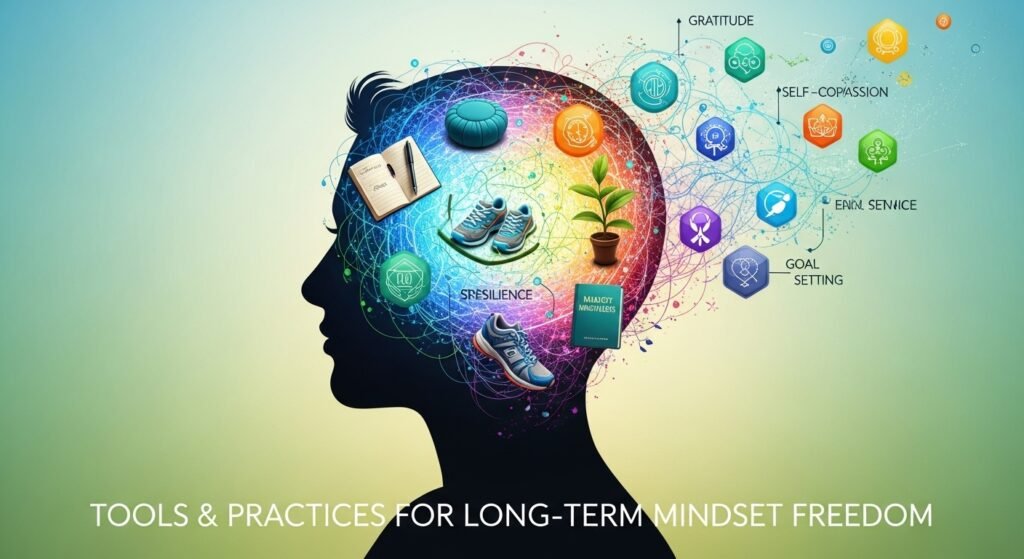
9. Tools & Practices for Long-Term Mindset Freedom
Achieving lasting mindset freedom calls for practical tools and steady habits.
Daily journaling helps track triggers and celebrate growth, while guided meditations or breathwork sessions calm the nervous system and rewire thought patterns.
Positive affirmations and visualization strengthen new, empowering beliefs over time.
Cognitive-behavioral techniques—like reframing negative thoughts—offer evidence-based ways to challenge old mental scripts.
By combining these practices with a supportive community or coach, you create a sustainable framework for lifelong mental clarity and resilience.
- Meditation & Breathwork for mental clarity.
- CBT techniques to restructure thoughts.
- Visualization boards to reinforce goals.
- Daily gratitude practice to reframe perspective.
- Support groups or masterminds for accountability.
- Regular exercise to boost endorphins.
- Affirmation audio loops for subconscious influence.
- Hypnotherapy to access deeper mind layers.
- Goal tracking apps for measurable progress.
- Ongoing learning to challenge old patterns.

10. Case Study: From Doubt to Confidence
Sarah once believed she wasn’t leadership material.
- She identified “I’m not good enough” as her limiting belief.
- Daily affirmations and journaling became her routine.
- She visualized herself leading with confidence.
- Small wins built momentum.
- Within a year, she became a respected manager.
- Her story proves mental reprogramming works.
- Consistency was her secret weapon.
- Support from a mentor kept her accountable.
- She now coaches others to break mental barriers.
- Your transformation can be just as profound.
11. Action Plan & Key Takeaways
Breaking Limiting Beliefs & Mental Reprogamming requires a clear, repeatable strategy.
Start by identifying and challenging negative thought patterns, then replace them with empowering affirmations and constructive self-talk.
Practice daily mindfulness or journaling to stay aware of progress and setbacks.
Surround yourself with supportive, growth-minded individuals who reinforce positive change.
Consistency is key—small, intentional actions every day will reprogram your mindset and unlock long-term personal growth.
- Identify one limiting belief today.
- Challenge it with evidence.
- Create a positive counter-belief.
- Repeat affirmations daily.
- Take one action within 24 hours to reinforce it.
- Track progress in a journal.
- Celebrate small successes.
- Share your journey for accountability.
- Revisit and refine beliefs regularly.
- Commit to lifelong mental growth.
12. FAQs
- What are limiting beliefs?
False assumptions that restrict growth and potential. - How do limiting beliefs form?
Through childhood messages, past failures, or cultural conditioning. - Can you share more limiting beliefs examples?
“I’m unlucky,” “Money is evil,” “I always fail,” etc. - What are the top 10 self-limiting beliefs?
See Section 4 for a full list. - How to overcome limiting beliefs effectively?
Follow the 6 steps: Awareness, Challenge, Evidence, Reframe, Act, Reinforce. - Why use positive affirmations?
They rewire the brain for success and replace negative self-talk. - How long does mental reprogramming take?
Often 21–60 days of consistent practice. - Is professional help necessary?
Not required but a therapist or coach can accelerate progress. - Can limiting beliefs return?
Yes, under stress; maintain ongoing awareness. - What’s the first step right now?
Write one belief and list three reasons it isn’t true.