🌱 The Breaking Point That Changed Everything
Sarah sat in her therapist’s office, tears streaming down her face, clutching her fifth self-help book on building confidence. “I’ve read every book, attended every seminar, and repeated every affirmation,” she whispered. “So why do I still feel like that scared 8-year-old girl when I try to speak up at work?”
Her therapist leaned forward gently. “Because, Sarah, you’re trying to grow wings while your emotional foundation is still cracked. You can’t build a skyscraper on quicksand.”
This moment would transform Sarah’s entire approach to personal development. Instead of pushing harder toward her goals, she began the uncomfortable but necessary journey of emotional healing. Six months later, not only had her confidence naturally emerged, but she’d also discovered something profound: all those years of “growth” attempts were actually sophisticated avoidance strategies keeping her trapped in the very patterns she sought to escape.
The hard truth that changed Sarah’s life—and will change yours: You cannot evolve without emotional repair.
📋 Table of Contents
- Growth vs. Healing: Understanding the Critical Difference
- The Science Behind Why Healing Must Come First
- 5 Signs You’re Trying to Grow Without Healing
- The Hidden Cost of Skipping Emotional Repair
- How to Know When You’re Ready for Growth
- The Integration Process: Healing and Growing Simultaneously
- Practical Strategies for Emotional Healing
- Building Sustainable Growth on Healed Foundations
- Common Pitfalls and How to Avoid Them
- The Complete Healing vs. Growth Framework
- Real-Life Transformation Stories
- Frequently Asked Questions
- Your Path Forward: Healing First, Growing Second
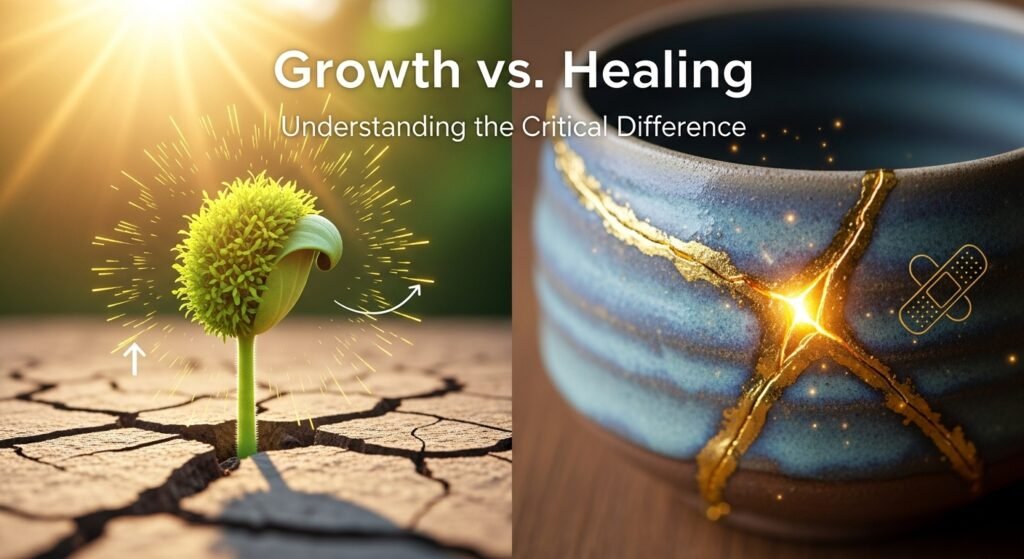
Growth vs. Healing: Understanding the Critical Difference
The distinction between growth vs. healing represents one of the most misunderstood concepts in personal development.
According to Dr. Yvette Erasmus, a leading psychologist in trauma-informed therapy, healing is “a transformative, emotional process that emerges within you in response to wounds you’re still carrying from past experiences.”
Growth, conversely, is “a dynamic, expansive process focused on acquiring knowledge, skills, and understanding for future development.”
Healing operates in the realm of emotion, sensation, and subconscious patterning. It’s messy, non-linear, and often feels like moving backward before moving forward.
When you’re healing, you’re not learning new skills—you’re unlearning protective patterns that once kept you safe but now limit your life.
You’re feeling emotions you buried, confronting beliefs you inherited, and gradually reclaiming parts of yourself you abandoned to survive.
Growth, on the other hand, operates in the realm of cognition, strategy, and conscious choice. It’s linear, measurable, and feels expansive.
Growth means learning new communication techniques, developing leadership skills, or expanding your knowledge base.
While healing asks “What do I need to feel?” growth asks “What do I need to know?” The critical insight is that healing creates the internal safety required for growth to be sustainable and authentic.
Key Takeaways:
- Healing is emotional and retrospective; growth is cognitive and prospective
- Healing feels messy and non-linear; growth feels structured and progressive
- Healing unlearns; growth learns
- Healing creates safety; growth creates expansion
- You cannot skip healing and expect sustainable growth
8 Core Differences Between Healing and Growth:
- Time Orientation: Healing focuses on past wounds; growth focuses on future potential
- Primary Domain: Healing works with emotions; growth works with cognition
- Process Nature: Healing is cyclical; growth is linear
- Comfort Level: Healing feels uncomfortable; growth feels exciting
- Evidence of Progress: Healing shows through emotional regulation; growth through skill acquisition
- Support Needs: Healing requires safety and witnessing; growth requires challenge and stretching
- Outcome Measure: Healing measures peace; growth measures achievement
- Integration Period: Healing needs absorption time; growth needs application time
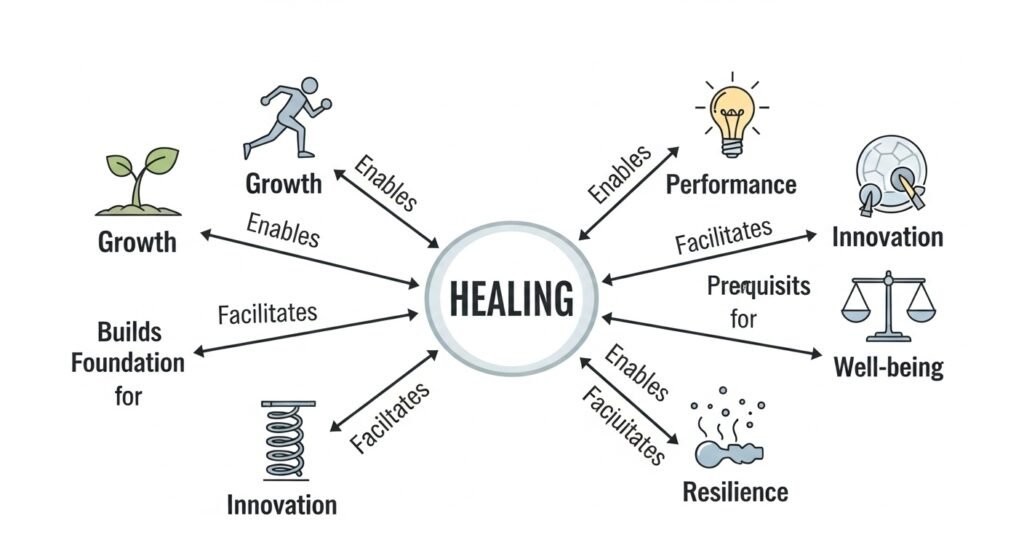
The Science Behind Why Healing Must Come First
Neuroscience research reveals compelling evidence about why emotional healing must precede personal growth attempts.
Studies from Harvard Medical School show that unprocessed trauma and emotional wounds keep the amygdala—the brain’s fear center—in a constant state of hyperarousal.
When this happens, the prefrontal cortex, responsible for learning and executive function, literally goes offline.
This means that no matter how many growth strategies you employ, your brain cannot effectively process or retain new information while operating from a wounded state.
Dr. Bessel van der Kolk’s groundbreaking research demonstrates that emotional wounds are stored not just in the mind but in the body itself.
His work shows that unprocessed trauma creates physiological changes—increased cortisol levels, disrupted sleep patterns, and chronic muscle tension—that directly interfere with the brain’s neuroplasticity required for learning and growth.
Essentially, your nervous system remains stuck in survival mode, making authentic growth impossible.
Furthermore, research on post-traumatic growth reveals that true transformation occurs only after emotional wounds are adequately processed.
The study published in Nature shows that individuals with high self-compassion experience stronger post-traumatic growth, but only after addressing the underlying emotional pain.
This creates a paradox: the very growth you’re seeking through avoidance of healing is only accessible through facing and processing your wounds.
Key Takeaways:
- Unprocessed trauma keeps the brain in survival mode
- The amygdala’s hyperarousal prevents effective learning
- Emotional wounds are stored physiologically, not just mentally
- Neuroplasticity requires emotional safety to function optimally
- Post-traumatic growth follows healing, not the reverse
8 Scientific Principles Supporting Healing First:
- Neuroplasticity Block: Trauma prevents formation of new neural connections
- Amygdala Hijack: Fear center overrides rational thinking during emotional triggers
- Cortisol Interference: Stress hormones impair memory formation and learning
- Polyvagal Theory: Nervous system must feel safe for social engagement and growth
- Memory Reconsolidation: Emotional memories must be accessed to be updated
- Default Mode Network: Brain’s self-referential processing is altered by trauma
- Epigenetic Changes: Trauma affects gene expression related to stress response
- Window of Tolerance: Emotional regulation capacity determines learning ability
5 Signs You’re Trying to Grow Without Healing
Recognizing when you’re attempting growth without emotional healing is crucial for breaking ineffective patterns.
One of the most telling signs is what psychologists call “spiritual bypassing” – using growth concepts like positive thinking, meditation, or productivity hacks to avoid facing emotional pain.
You might find yourself constantly seeking the next workshop, book, or technique while consistently avoiding stillness or emotional discomfort.
This creates an illusion of progress while maintaining the same underlying wounds.
Another clear indicator is pattern repetition despite knowledge acquisition. You understand relationship dynamics intellectually but keep attracting the same type of partner.
You know communication strategies but still find yourself in destructive arguments. You study financial management but continue self-sabotaging behaviors.
This happens because unhealed emotional wounds drive behavior regardless of intellectual understanding. Your knowledge has outpaced your emotional capacity.
Physical symptoms often emerge when growth attempts outpace healing.
Chronic fatigue, digestive issues, headaches, or insomnia can indicate that your body is holding unprocessed emotional tension.
Your nervous system is essentially saying “stop avoiding and start feeling” through physical distress.
Many people misinterpret these signals as obstacles to push through rather than invitations to slow down and heal.
Key Takeaways:
- Spiritual bypassing masks avoidance with growth activities
- Pattern repetition despite knowledge indicates unhealed wounds
- Physical symptoms often signal emotional avoidance
- Intellectual understanding doesn’t equal emotional capacity
- Growth without healing creates sophisticated self-deception
8 Warning Signs of Growth Without Healing:
- Constant Seeking: Always looking for the next book, workshop, or guru
- Emotional Numbness: Difficulty accessing or identifying feelings
- Performance Pressure: Feeling you must always be “evolving” or “improving”
- Relationship Stagnation: Same conflicts despite relationship knowledge
- Physical Symptoms: Chronic tension, fatigue, or health issues
- Intellectual Arrogance: Using knowledge to avoid vulnerability
- Emotional Reactivity: Big reactions to small triggers
- Isolation Patterns: Avoiding deep connection while seeking self-improvement
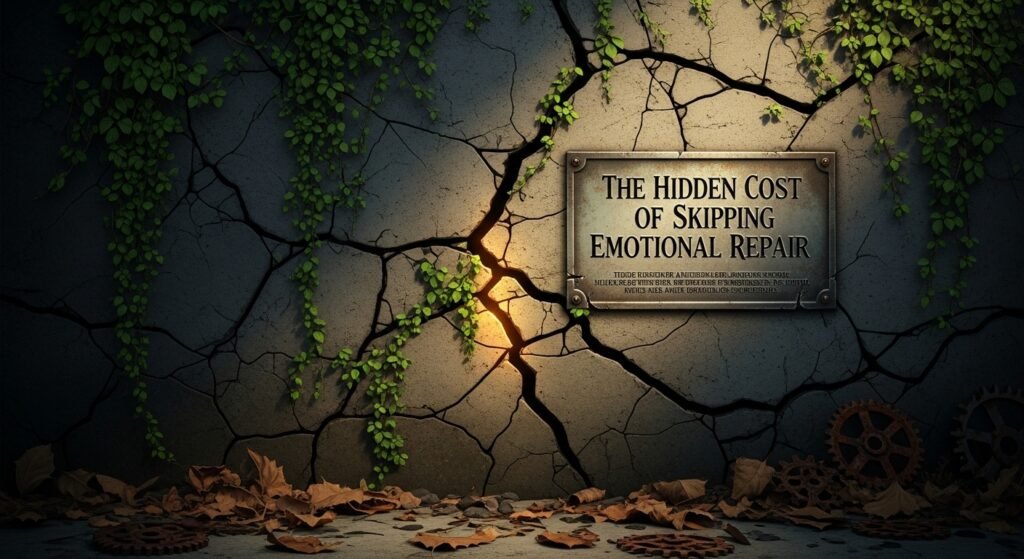
The Hidden Cost of Skipping Emotional Repair
The consequences of attempting growth without emotional healing extend far beyond temporary frustration.
Research from the American Psychological Association shows that individuals who engage in continuous self-improvement without addressing underlying emotional wounds develop what researchers term “growth fatigue” – a state of chronic stress, cynicism, and eventual burnout that can take years to recover from.
This happens because the nervous system remains in a perpetual state of striving without ever reaching the safety required for true integration.
Perhaps more insidiously, growth without healing often reinforces the very patterns it seeks to overcome.
When you build new skills on a foundation of unworthiness, you inadvertently strengthen the belief that you’re not okay as you are.
Each achievement becomes evidence that you must constantly prove your value, creating an endless cycle of striving that never satisfies.
The wound of “not enough” remains untouched while you accumulate external validations.
The relational cost is equally significant. Unhealed emotional wounds create blind spots that damage relationships regardless of your growth efforts.
You might master communication techniques but still abandon yourself in relationships, over-function to earn love, or maintain emotional walls while claiming vulnerability.
Partners, friends, and family members experience the disconnect between your growth persona and your emotional availability, often feeling unseen or used in your self-improvement journey.
Key Takeaways:
- Growth fatigue leads to chronic stress and eventual burnout
- Unhealed wounds create cycles of perpetual striving
- Skill-building on unworthiness reinforces inadequacy beliefs
- Relationships suffer from emotional unavailability masked by growth
- The cost compounds over time, making later healing more difficult
8 Hidden Costs of Avoiding Emotional Healing:
- Compound Interest: Wounds deepen and become more entrenched over time
- Authenticity Loss: Disconnect between inner experience and outer presentation
- Relationship Sabotage: Partners experience emotional unavailability despite growth efforts
- Financial Drain: Continuous spending on growth programs without lasting change
- Identity Confusion: Not knowing who you are beyond achievements and improvements
- Trust Issues: Difficulty trusting yourself when growth doesn’t create lasting change
- Physical Burnout: Adrenal fatigue and stress-related health conditions
- Spiritual Bypass: Using growth concepts to avoid genuine spiritual development
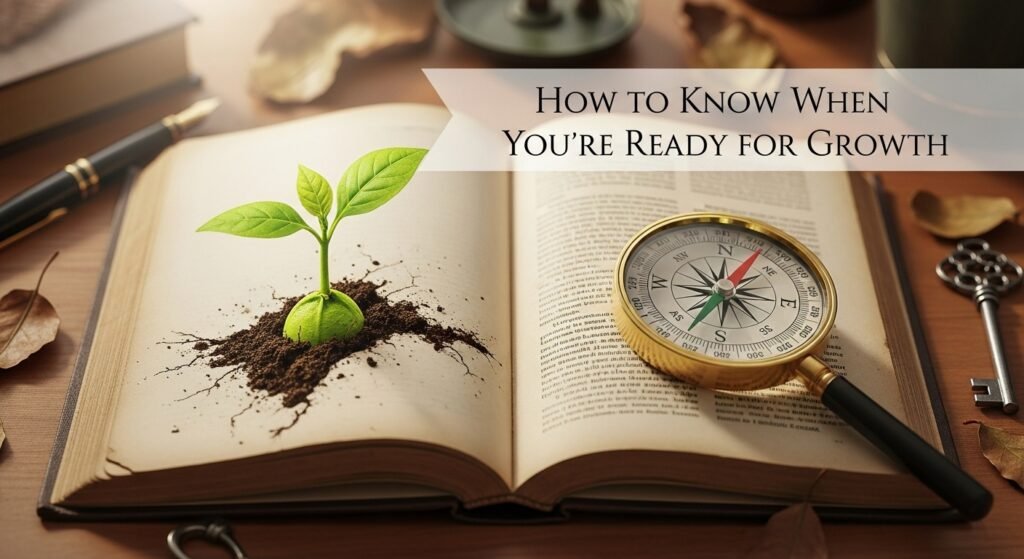
How to Know When You’re Ready for Growth
Understanding when you’ve completed sufficient emotional healing to support sustainable growth is crucial for timing your development efforts.
One of the clearest indicators is emotional regulation capacity – you can feel difficult emotions without becoming overwhelmed or reactive.
When triggered, you have tools to self-soothe and can return to baseline relatively quickly.
This doesn’t mean you never feel triggered, but you have a relationship with your emotional experience that includes curiosity rather than judgment.
Another readiness sign is the ability to hold paradox and complexity.
Healed individuals can acknowledge both their wounds and their wisdom, see both the harm caused by others and their own agency, and hold space for both grief and gratitude.
This cognitive flexibility indicates that your nervous system has moved out of survival mode and can support the nuanced thinking required for growth.
You no longer need simple answers or binary thinking to feel safe.
Perhaps most importantly, readiness for growth includes genuine self-compassion rather than self-improvement motivation.
You’re no longer trying to fix yourself because you recognize you’re not broken.
Your desire for growth comes from self-love and expansion rather than self-rejection and inadequacy.
You want to grow because you care about yourself and your impact, not because you believe you’re fundamentally flawed.
Key Takeaways:
- Emotional regulation indicates healing progress
- Ability to hold complexity shows nervous system safety
- Self-compassion replaces self-improvement motivation
- Growth desire stems from love rather than inadequacy
- Readiness includes tolerance for discomfort without overwhelm
8 Signs You’re Ready for Sustainable Growth:
- Emotional Regulation: Can process difficult feelings without shutdown or overwhelm
- Self-Compassion: Treat yourself with kindness rather than criticism
- Paradox Tolerance: Hold multiple perspectives simultaneously
- Trigger Recovery: Return to baseline quickly after emotional activation
- Authentic Desire: Want growth from expansion, not inadequacy
- Boundary Awareness: Know and respect your limits without shame
- Support Capacity: Can receive help without losing self-trust
- Present Focus: Spend more time in current experience than past/future

The Integration Process: Healing and Growing Simultaneously
While healing must precede significant growth, the most effective personal development integrates both processes strategically.
This integration involves creating a rhythm that honors your emotional needs while gradually expanding your capacity.
Think of it as emotional interval training – periods of healing focus followed by growth phases, with rest periods for integration.
This prevents the exhaustion that comes from continuous emotional work while avoiding the bypassing that occurs with constant striving.
The key to integration is learning to read your system’s signals accurately.
Your body and emotions provide constant feedback about whether you’re expanding too quickly or avoiding necessary healing.
Physical tension, emotional reactivity, or loss of joy indicate you need more healing focus.
Boredom, stagnation, or lack of challenge suggest readiness for growth expansion.
This somatic awareness allows you to adjust your focus in real-time rather than following rigid schedules.
Successful integration also requires different support systems for different phases.
Healing phases benefit from therapeutic support, gentle practices, and witnessing presence.
Growth phases thrive with coaching, challenge, and accountability.
Understanding which support serves each process prevents the common mistake of using growth-oriented support during healing phases (which can trigger shame) or therapeutic support during growth phases (which can enable avoidance).
Key Takeaways:
- Integration involves rhythm between healing and growth phases
- Somatic awareness guides real-time adjustments
- Different phases require different support systems
- Rest periods are essential for integration
- Flexibility prevents both exhaustion and avoidance
8 Integration Strategies for Healing and Growth:
- Phase Cycling: Alternate between healing focus and growth focus periods
- Somatic Tracking: Monitor body signals for system overload or readiness
- Support Matching: Align support type with current phase needs
- Integration Periods: Schedule rest time between intensive phases
- Gentle Transitions: Gradually shift between healing and growth focus
- Dual Practices: Include both healing and growth elements in daily routine
- Feedback Loops: Regular assessment of what’s working and what needs adjustment
- Flexibility Principles: Adapt plans based on current capacity, not rigid schedules

Practical Strategies for Emotional Healing
Effective emotional healing requires specific practices that address wounds at their root rather than managing symptoms.
One of the most powerful approaches is parts work, which recognizes that wounded aspects of ourselves remain frozen in the past, continuing to drive current behavior.
By connecting with these parts with compassion rather than judgment, we can provide the witnessing and support they needed during original wounding experiences.
This might involve dialoguing with your inner child, understanding protective patterns, or acknowledging exiled emotions.
Somatic healing practices are equally crucial since emotional wounds are stored physiologically.
Techniques like somatic experiencing, EMDR (Eye Movement Desensitization and Reprocessing), or simple body awareness exercises help release stored tension and complete interrupted survival responses.
This might involve noticing where you hold tension during emotional triggers, practicing grounding exercises when activated, or allowing your body to complete movements it couldn’t make during original wounding.
Emotional regulation skills provide the foundation for safe healing work.
Before diving into painful memories, you need tools to manage overwhelming feelings.
This includes breathing techniques, self-soothing practices, and ways to titrate emotional intensity so you process rather than retraumatize.
These skills ensure that healing work expands your window of tolerance rather than overwhelming your system.
Key Takeaways:
- Parts work addresses wounded aspects frozen in the past
- Somatic practices release stored physiological tension
- Emotional regulation provides safety for healing work
- Compassion rather than judgment facilitates integration
- Professional support often necessary for deep wounds
8 Evidence-Based Healing Practices:
- Parts Work Therapy: Connect with and heal wounded inner aspects
- Somatic Experiencing: Release stored survival energy from the body
- EMDR Processing: Reprocess traumatic memories with bilateral stimulation
- Emotional Regulation Training: Develop capacity to manage intense feelings
- Self-Compassion Practice: Treat yourself with kindness during difficult moments
- Boundary Restoration: Rebuild ability to protect your emotional space
- Grief Work: Process losses that created protective patterns
- Attachment Repair: Heal relational wounds through therapeutic relationship

Building Sustainable Growth on Healed Foundations
Once emotional healing has created internal safety and self-trust, growth becomes a natural expansion rather than forced striving.
Sustainable growth builds incrementally, allowing your nervous system to accommodate new capacities without triggering old survival patterns.
This means setting goals that stretch but don’t overwhelm, celebrating small wins that build confidence, and maintaining practices that keep you connected to your healed foundation.
The key to sustainable growth is alignment – ensuring your expansion goals reflect your authentic desires rather than inherited shoulds or wound-driven compensations.
This requires regular self-inquiry about motivation: Are you pursuing this goal because it excites you or because you believe it will finally make you enough?
Goals aligned with your healed self feel energizing rather than depleting, expansive rather than constricting, and purposeful rather than performative.
Sustainable growth also includes maintenance practices that prevent backsliding into old patterns.
This might involve regular emotional check-ins, continued therapeutic support, or practices that keep you connected to your values and authentic self.
Growth isn’t a destination but a way of living that requires ongoing attention to both healing and expansion needs.
Key Takeaways:
- Sustainable growth builds on healed foundations incrementally
- Alignment with authentic desires prevents wound-driven striving
- Maintenance practices prevent backsliding into old patterns
- Growth becomes natural expansion rather than forced effort
- Regular self-inquiry ensures motivation remains healthy
8 Principles for Sustainable Growth:
- Incremental Expansion: Set goals that stretch without overwhelming
- Authentic Alignment: Ensure goals reflect true desires, not wound compensations
- Celebration Practice: Acknowledge small wins to build confidence
- Nervous System Monitoring: Watch for signs of activation or shutdown
- Value Connection: Regularly reconnect with core values and purpose
- Support Maintenance: Continue therapeutic or community support as needed
- Flexibility Adjustment: Modify goals based on current capacity and needs
- Integration Time: Allow periods for absorbing and embodying changes
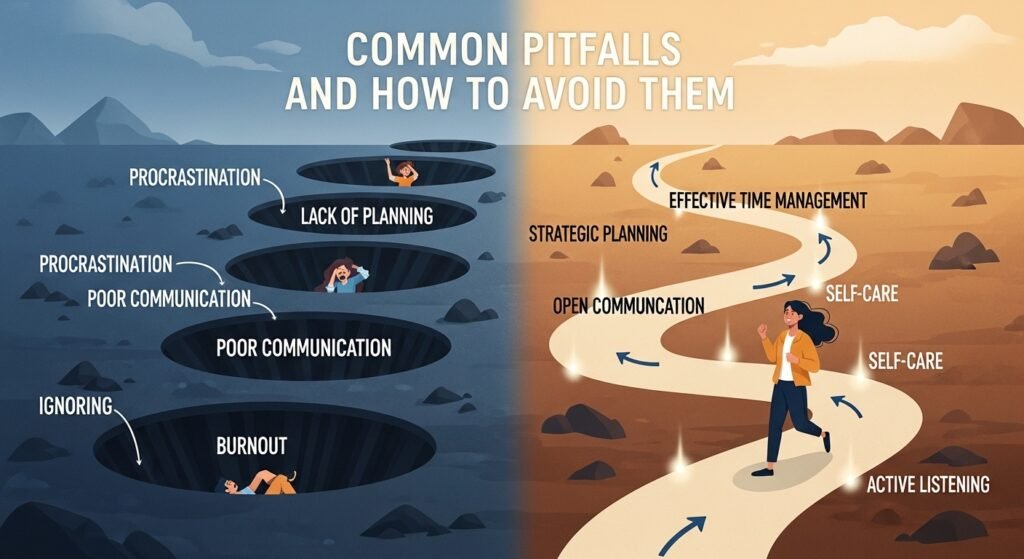
Common Pitfalls and How to Avoid Them
Even with the best intentions, the healing and growth journey includes predictable challenges that can derail progress.
One of the most common pitfalls is the healing trap – becoming so identified with the healing process that it becomes a new identity rather than a pathway to wholeness.
This might involve constantly processing wounds without moving toward integration, using healing language to avoid taking responsibility, or creating a victim identity that prevents growth.
The antidote is setting clear intentions for healing work and regularly assessing whether it’s creating more freedom or more limitation.
Another significant pitfall is growth addiction – the compulsive pursuit of expansion to avoid feeling inadequate or incomplete.
This shows up as constant course-taking, workshop-attending, or goal-setting without ever feeling satisfied with current accomplishments.
Growth addicts use achievement like a drug, getting temporary highs from new accomplishments but quickly needing another fix.
This often masks the same unworthiness wounds that healing work would address, creating a sophisticated avoidance pattern that’s hard to recognize.
The comparison trap derails many healing and growth efforts by creating unrealistic standards and timelines.
Comparing your journey to others’ highlight reels on social media, expecting linear progress based on others’ stories, or judging your pace against external benchmarks creates shame and frustration that blocks both healing and growth.
Remember that healing and growth are highly individual processes that follow their own timeline and path.
Key Takeaways:
- Healing trap creates identity around wounds rather than wholeness
- Growth addiction masks unworthiness with achievement
- Comparison creates unrealistic standards and timelines
- Both healing and growth require individual pacing and paths
- Regular assessment prevents patterns from becoming traps
8 Common Pitfalls and Solutions:
- Healing Identity: Solution – Set completion intentions and celebrate integration
- Growth Addiction: Solution – Practice satisfaction with current accomplishments
- Comparison Trap: Solution – Focus on personal progress rather than external benchmarks
- Perfectionism: Solution – Embrace messy, imperfect progress
- Timeline Pressure: Solution – Trust individual pacing and organic timing
- Support Dependency: Solution – Gradually increase self-trust and internal resources
- All-or-Nothing Thinking: Solution – Appreciate incremental progress and gray areas
- Spiritual Bypassing: Solution – Face difficult emotions rather than transcending them
📊 The Complete Healing vs. Growth Framework {#comparison-table}
| Aspect | Emotional Healing | Personal Growth | Integration Phase |
|---|---|---|---|
| Primary Focus | Processing past wounds | Acquiring future skills | Balancing both processes |
| Time Orientation | Past-oriented | Future-oriented | Present-centered |
| Energy Quality | Receptive, allowing | Active, striving | Rhythmic, flowing |
| Support Needs | Witnessing, safety | Challenge, accountability | Flexibility, attunement |
| Progress Indicators | Emotional regulation | Skill acquisition | Sustainable change |
| Common Pitfalls | Becoming identified with wounds | Addiction to achievement | Losing balance between processes |
| Physiological State | Parasympathetic activation | Sympathetic activation | Balanced nervous system |
| Timeline | Non-linear, cyclical | Linear, progressive | Rhythmic, seasonal |
| Success Measures | Inner peace, self-trust | Achievement, capability | Authentic expression |
| Daily Practices | Self-compassion, regulation | Goal-setting, skill-building | Intuitive adjustment |
💫 Real-Life Transformation Stories
Maria’s Journey:
After 15 years in corporate leadership, Maria couldn’t understand why success felt so empty.
Despite mastering every growth strategy available, she battled chronic anxiety and felt like an imposter.
When she began focusing on healing her childhood emotional neglect, she discovered that her entire career was built on proving her worth to unavailable parents.
Through two years of focused healing work, including inner child therapy and somatic experiencing, Maria’s anxiety dissolved naturally.
She describes the aftermath: “For the first time, I made decisions based on what excited me, not what would impress others.
My career actually accelerated, but now it feels like play, not performance.”
James’ Breakthrough:
A serial entrepreneur, James had built and sold three companies by age 35 but couldn’t maintain intimate relationships.
Each business success was followed by relationship failure, creating a pattern he couldn’t break.
Traditional therapy helped him understand his abandonment fears intellectually, but healing work allowed him to actually feel and release the terror he’d carried since his mother’s death at age 7.
“The healing was excruciating,” James shares. “I had to feel the abandonment I’d been running from my entire life.But once I processed it, I stopped creating businesses that required total abandonment of my personal life. My current company supports my life instead of consuming it.”
Sarah’s Integration:
A self-help junkie since college, Sarah had shelves of books and certificates from countless workshops.
Yet she still found herself in toxic relationships and struggled with chronic fatigue.
Her breakthrough came when she realized she’d been using growth to avoid healing.
“I was addicted to becoming ‘better’ because I couldn’t tolerate who I actually was,” she explains.
Sarah spent 18 months in intensive healing work before returning to growth activities. “Now when I learn something new, it integrates immediately because I’m not fighting my own resistance. The growth actually sticks.”
❓ Frequently Asked Questions About Growth vs. Healing
Q1: Can I heal and grow at the same time?
A: While healing must precede significant growth, you can integrate both processes strategically. The key is recognizing which phase you’re in and adjusting your focus accordingly. During healing phases, prioritize emotional processing and safety. During growth phases, emphasize skill-building and expansion while maintaining healing practices as foundation.
Q2: How do I know if I need healing or just need to try harder with growth?
A: If you consistently understand what to do but can’t seem to do it, you likely need healing. Pattern repetition despite knowledge, emotional reactivity to small triggers, and physical symptoms like chronic fatigue or tension are signs that emotional wounds are driving behavior. Growth feels expansive; healing feels necessary.
Q3: What if I’ve been in therapy for years but still feel stuck?
A: Traditional talk therapy sometimes focuses on understanding rather than processing. You might need somatic approaches, parts work, or trauma-specific modalities like EMDR. Also assess whether you’ve been using therapy to understand rather than to feel and release. Healing requires emotional processing, not just intellectual insight.
Q4: How long does healing take before I can focus on growth?
A: Healing timelines vary significantly based on wound severity, support quality, and your capacity for emotional processing. Some people see shifts in months; others need years. Focus on developing emotional regulation capacity and self-compassion rather than arbitrary timelines. You’ll know you’re ready when growth feels exciting rather than overwhelming.
Q5: Is it possible to over-focus on healing and avoid growth?
A: Yes, some people become identified with their healing journey and use it to avoid taking action or responsibility. Signs include constantly processing without integration, using healing language to avoid accountability, or feeling like you’ll never be “healed enough” to move forward. Set intentions for completion and integration.
Q6: What’s the difference between healing and just dwelling on the past?
A: Healing processes past experiences to release their current grip on your life. Dwelling keeps you stuck in victim identity without movement toward wholeness. Healing includes grief, anger, and pain but moves toward integration and peace. Dwelling reinforces powerlessness; healing restores agency.
Q7: Can reading self-help books actually interfere with healing?
A: Growth-focused self-help can become sophisticated avoidance when used to bypass emotional work. If you find yourself constantly seeking the next book or technique without implementing changes, you might be using growth to avoid healing. Balance intellectual learning with emotional processing and body-based practices.
Q8: How do I find the right support for healing vs. growth phases?
A: Healing phases benefit from trauma-informed therapists, support groups, and body-based practitioners who can hold space for emotional processing. Growth phases thrive with coaches, mentors, and educational programs that provide challenge and accountability. Be honest about your current needs rather than seeking the most prestigious support.
Q9: What if my healing triggers anxiety about falling behind in life?
A: This anxiety often reflects wound-driven beliefs about worth being tied to achievement. True healing includes grieving the time spent surviving and trusting that authentic growth will be more sustainable than forced progress. Many people find that healing actually accelerates meaningful achievement once foundations are secure.
Q10: How do I explain my healing focus to friends/family who expect constant achievement?
A: You don’t owe anyone detailed explanations about your process. Simple boundaries like “I’m focusing on my emotional health right now” or “I’m taking time to build stronger foundations” are sufficient. Remember that people who benefit from your over-functioning might resist your healing – their discomfort isn’t your responsibility.
🎯 Your Path Forward: Healing First, Growing Second
The journey of personal evolution isn’t about choosing between healing and growth – it’s about honoring the natural sequence that makes sustainable transformation possible.
Like the seasons that must follow their cycle, your development requires the fallow time of healing before the expansion of growth can take root and flourish.
Remember Sarah from our opening story? Six months after shifting from growth obsession to healing focus, she landed her dream job – not through force of will, but through the natural confidence that emerged from emotional repair. “I didn’t get confident by building confidence,” she reflects. “I got confident by healing the parts that were terrified to be seen.”
This is the paradox and promise of authentic evolution: when you stop trying to grow and start allowing healing, growth becomes inevitable.
The very expansion you seek through effort emerges effortlessly from wholeness.
Your Next Steps:
- Pause the striving – Take honest inventory of whether you’ve been using growth to avoid healing
- Create safety first – Establish practices that help you feel emotionally regulated and grounded
- Seek appropriate support – Find trauma-informed help if you’re dealing with significant wounds
- Trust your timing – Release arbitrary deadlines and trust your system’s natural rhythm
- Celebrate integration – Acknowledge when healing creates natural, sustainable growth
The truth that will transform your journey: You are not broken – you are becoming.
Healing isn’t fixing something wrong with you; it’s removing the obstacles to your natural evolution.
Growth isn’t becoming someone else; it’s expanding into who you already are beneath the wounds.
Final wisdom to carry forward: The most profound growth doesn’t come from adding more to yourself – it comes from removing what isn’t you.
Start there.
Everything else follows naturally.
Your authentic evolution awaits. 🌱
Ready to honor your healing journey? Share this with someone who needs permission to pause their growth obsession and focus on emotional repair. The courage to heal creates the foundation for growth that actually lasts.